Guide
🇦🇺 The Golden Ticket: Your 30-Day Pre-Departure Masterclass
Moving to Australia is one of the biggest decisions of your life — and the 30 days before you board that flight are the most important of your entire migration journey. This guide walks you through every task, every document, and every decision you need to make before you leave home, so you arrive in Australia ready to hit the ground running.
- Your Australian visa grant letter or visa label
- Valid passport (at least 6 months validity beyond intended arrival)
- Confirmed accommodation address for first night in Australia
- A list of any qualifications, employment letters, or study documents relevant to your visa type
- International students (subclass 500)
- Temporary skilled workers (subclass 482, 491)
- Graduate visa holders (subclass 485)
- Working holiday makers (subclass 417, 462)
- Permanent residents preparing to depart
- Any migrant in the 30 days before arrival in Australia
Key topics covered
About SettleMate
SettleMate is an Australian settlement platform that helps new migrants, international students, and visa holders move to Australia with confidence using step-by-step guides and practical checklists.
This guide is part of SettleMate’s official settlement resources, created from real migrant experiences and current Australian requirements.
You've done it. The visa is approved. The ticket is booked. You're going to Australia.
But here's what nobody tells you: the 30 days before you board that flight are arguably the most important of your entire migration. The decisions you make right now, the documents you gather, the accounts you open, the insurance you arrange, will determine whether your first week in Australia is smooth or a scramble.
Most migrants arrive in Australia underprepared. They're scrambling for a sim card at the airport, unsure whether they need a TFN before they start work, carrying food items they'll have to throw out at customs, and spending their first week hunting for documents they left at home. All of this is avoidable.
This guide by SettleMate walks you through every task you need to complete in the 30 days before your flight. We've broken it into clear weekly phases, from big-picture preparation in Week 1 all the way to the final 24 hours before you board. Work through this guide and you'll land in Australia with everything in place.
📋 YOUR 30-DAY OVERVIEW
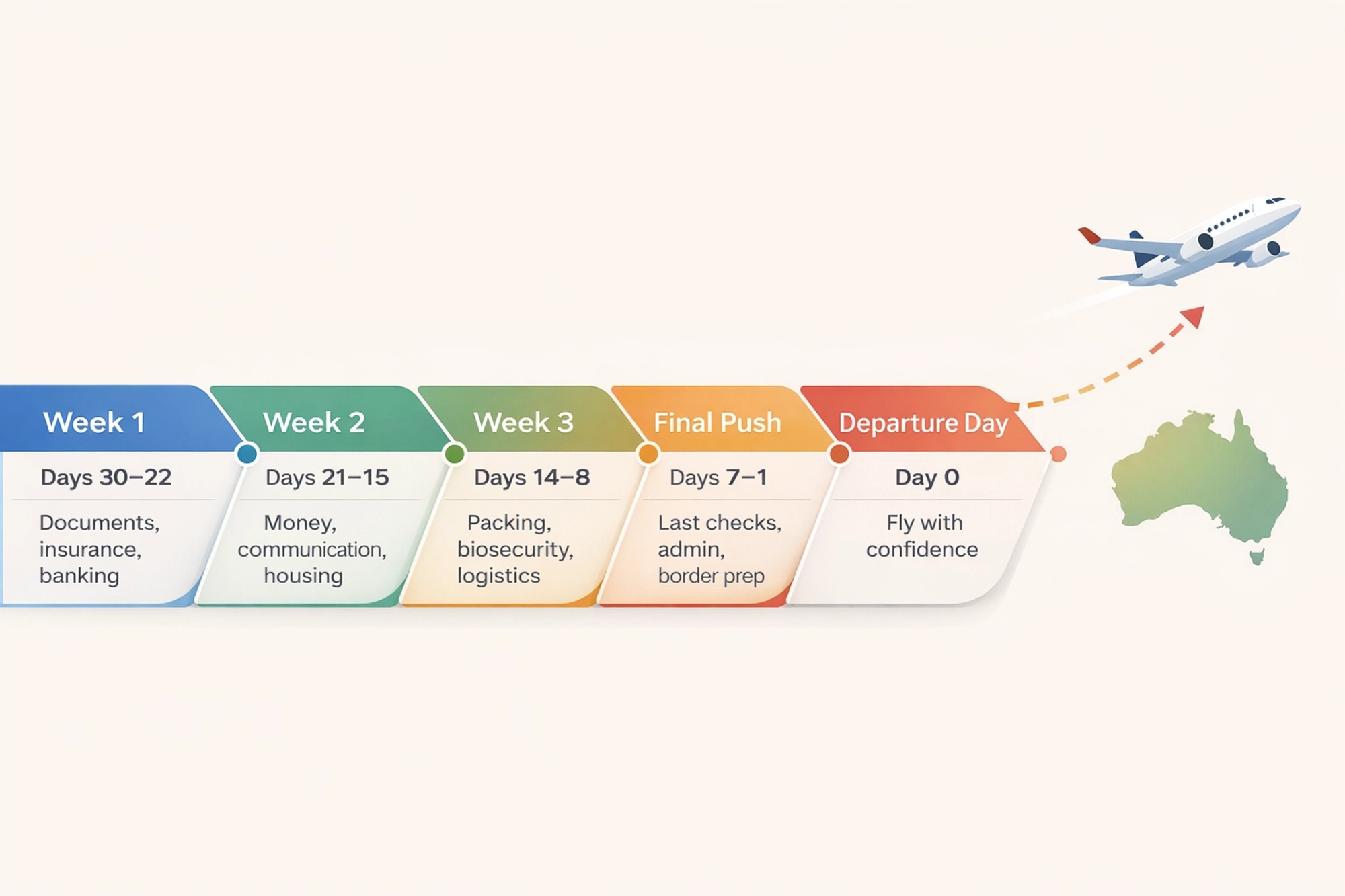
🟦 WEEK 1 (Days 30–22): The Foundation Phase
This is where you tackle the big, slow-moving tasks — the ones that take time to process, like insurance applications and bank account setup. Start these first.
📄 Step 1: Do a Full Visa and Document Audit
Before you do anything else, pull together every document you have and go through them one by one. This sounds simple but most migrants skip it and then discover a problem at the airport.

✅ Visa Grant Letter — Check Every Condition
Your visa grant letter is not just confirmation you can travel. It contains your visa conditions — including work rights, study restrictions, and re-entry rules. Read it. Know it.
Key things to confirm right now:
- Your visa subclass number (e.g. 500, 482, 485, 417)
- Work rights — How many hours per fortnight can you work?
- Visa expiry date — Is there enough time for your initial plans?
- Re-entry conditions — Is your visa multiple-entry or single-entry?
SettleMate's Tip: SettleMate recommends checking your visa conditions via VEVO (Visa Entitlement Verification Online) at immi.homeaffairs.gov.au, not just from the grant letter. VEVO is the official real-time record of your visa status — employers, landlords, and banks can use it to verify your rights. Bookmark it before you leave.
✅ Passport Validity
Your passport must be valid for the duration of your stay in Australia. While the official rule states your passport must be valid, as a practical standard, most airlines and immigration officers expect at least 6 months validity beyond your intended return date. If your passport expires within 12 months, renew it before travelling.
Also check:
- Blank visa pages — You'll need at least 2 blank pages for arrival stamps
- Name consistency — Your name on your visa must exactly match your passport. Even a small discrepancy (e.g. "Mohammed" vs "Mohammad") can cause serious issues at the border. If there's a mismatch, contact the Department of Home Affairs immediately.
✅ Supporting Documents to Carry (Originals + Copies)
Depending on your visa type, you may need to carry:
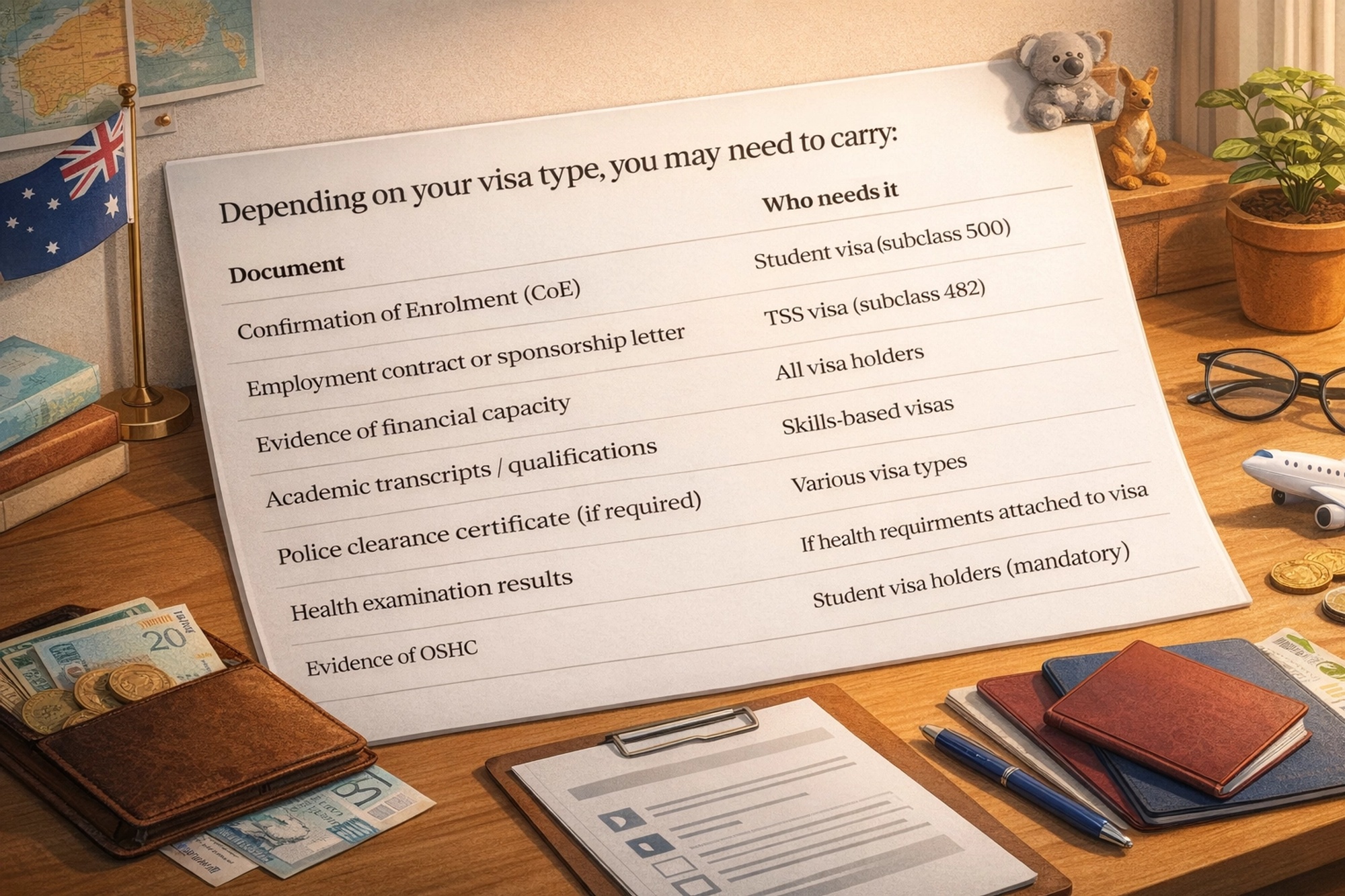
SettleMate's Tip: SettleMate recommends carrying both original documents AND certified copies. Keep originals in your carry-on and copies in your checked luggage. Also scan everything and email them to yourself — if your bags are lost, your documents aren't.
🏥 Step 2: Arrange Health Insurance Before You Leave
This is one of the tasks people most commonly leave too late — and it can cost you thousands if you get sick in your first week.
✅ Which insurance do you need?
Student visa (subclass 500): You are required by law to hold Overseas Student Health Cover (OSHC) for the duration of your student visa. Your education provider will usually arrange this as part of your enrolment, but you must confirm it's active before you travel. OSHC covers GP visits, hospital treatment, ambulance, and some prescription medicines.
Working holiday (subclass 417/462) and TSS visa (482): You are not eligible for Medicare (Australia's public health system) unless you're from a Reciprocal Health Care Agreement (RHCA) country. If you're from the UK, Ireland, New Zealand, Sweden, Norway, Finland, Netherlands, Belgium, Italy, Malta, or Slovenia, you can access medically necessary care through Medicare while in Australia. Everyone else needs Overseas Visitor Health Cover (OVHC).
Permanent residents and partner visa applicants: You are generally eligible for Medicare once your permanent visa is granted. Enrolment can be done after arrival through myGov. Check with Services Australia at servicesaustralia.gov.au to confirm your visa's eligibility before assuming you're covered.
491 and 494 visa holders: Good news — holders of the new Regional Provisional visas (subclass 491 and 494) are eligible for Medicare.
SettleMate's Tip: SettleMate sees many migrants arrive assuming they'll be covered by Medicare and discover they're not. Medical costs without insurance in Australia are genuinely high — a single GP visit without bulk billing can cost $80–$120, and a hospital stay can produce bills in the tens of thousands. If in doubt, purchase OVHC. It is far cheaper than the alternative. Always verify your Medicare eligibility at servicesaustralia.gov.au before assuming coverage.
✅ OSHC providers (for student visa holders)
The Australian Government's approved OSHC providers include: Allianz Care Australia, BUPA Australia, CBHS International Health, Medibank, and nib. Your education institution may have a preferred provider — check with them first.
🏦 Step 3: Open Your Australian Bank Account Before You Arrive
One of the smartest moves you can make before leaving is opening an Australian bank account from overseas — so you arrive with an account ready to receive your first salary, pay your rental bond, and have your debit card waiting.
✅ Which banks allow pre-arrival account opening?
Australia's "Big Four" banks all have migrant-friendly banking products. Here's what to know for 2026:
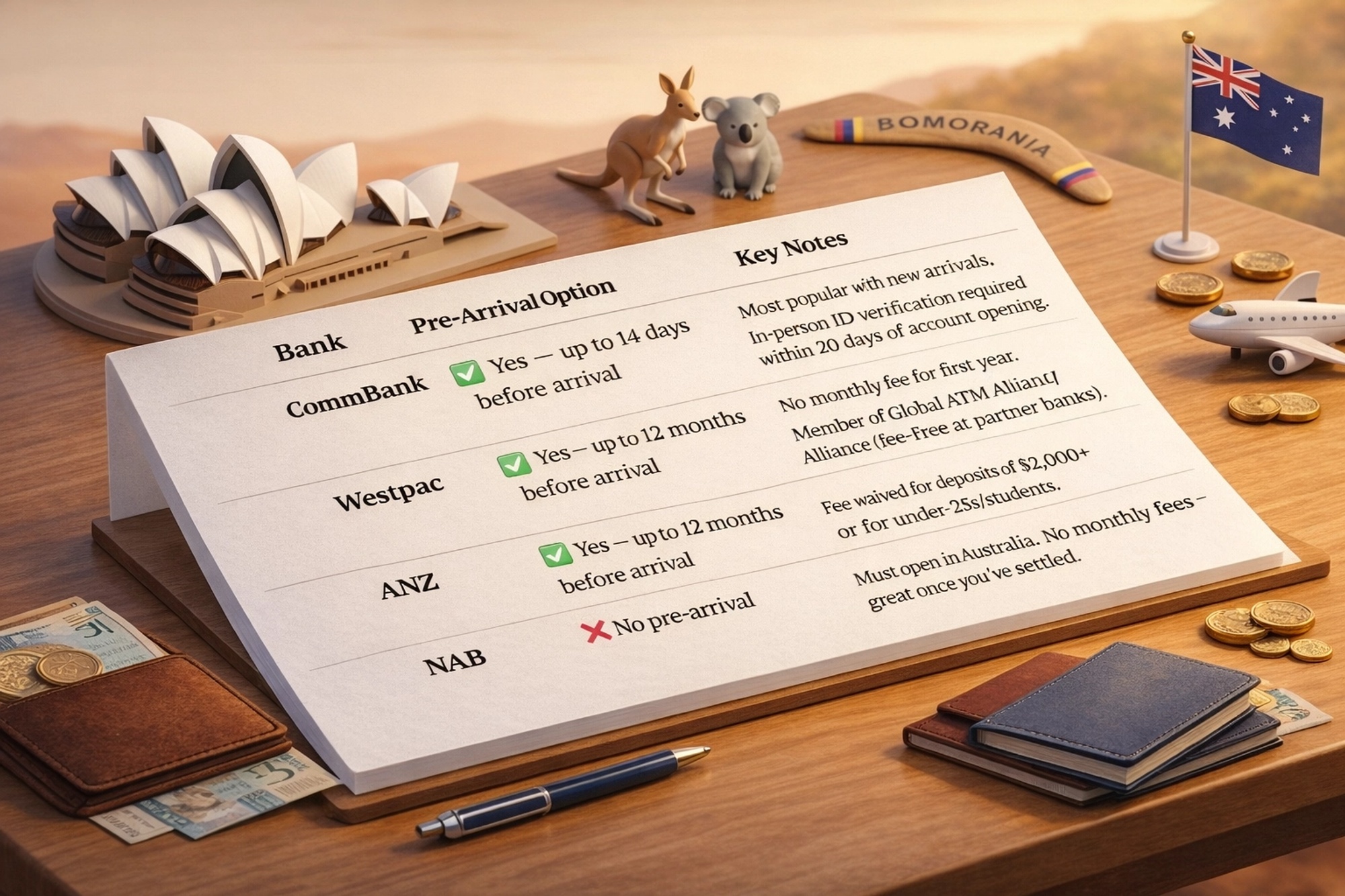
For CommBank specifically: once your account is in deposit-only mode, you can start receiving transfers (e.g. transferring your own funds from home) immediately. You just can't withdraw until you verify your identity in-branch after landing.
✅ What you'll need to apply online
- Valid passport
- Visa grant number / visa details
- Australian address (even a temporary hotel address is fine)
- Email address
SettleMate's Tip: SettleMate recommends opening your bank account within Week 1 of your 30-day countdown — not in the final days. Banks can take time to process your application, mail your card, or complete verification. Aim to land with your card already in your wallet. Also: once you have your account, do NOT share your account number, BSB, or card details via WhatsApp, email, or informal channels. Banking scams targeting new migrants are common in Australia.
🟩 WEEK 2 (Days 21–15): Money, Communication & Housing
With your foundation set, Week 2 is about getting your financial and communication infrastructure in place.
💸 Step 4: Sort Your Money — Transfers, Currency, and Cards
You need money in Australia from Day 1. Here's how to move it smartly.
✅ How much money should you bring?
There's no fixed minimum the Australian Government requires you to have to enter (for most visa types), but as a general planning guide:
- First week essential costs: Accommodation, transport, SIM card, groceries — budget at least AUD $500–$800 for this
- Rental bond: Typically 4 weeks' rent, paid upfront before you can move into any rental property
- OSHC/OVHC premiums: If not paid pre-arrival, these can be several hundred dollars
- Overall recommended buffer: Most settlement advisers suggest arriving with at least AUD $3,000–$5,000 accessible, especially if you don't have a job lined up immediately
If you're carrying AUD $10,000 or more in cash (or the foreign equivalent), you are legally required to declare it on your Incoming Passenger Card at the Australian border.
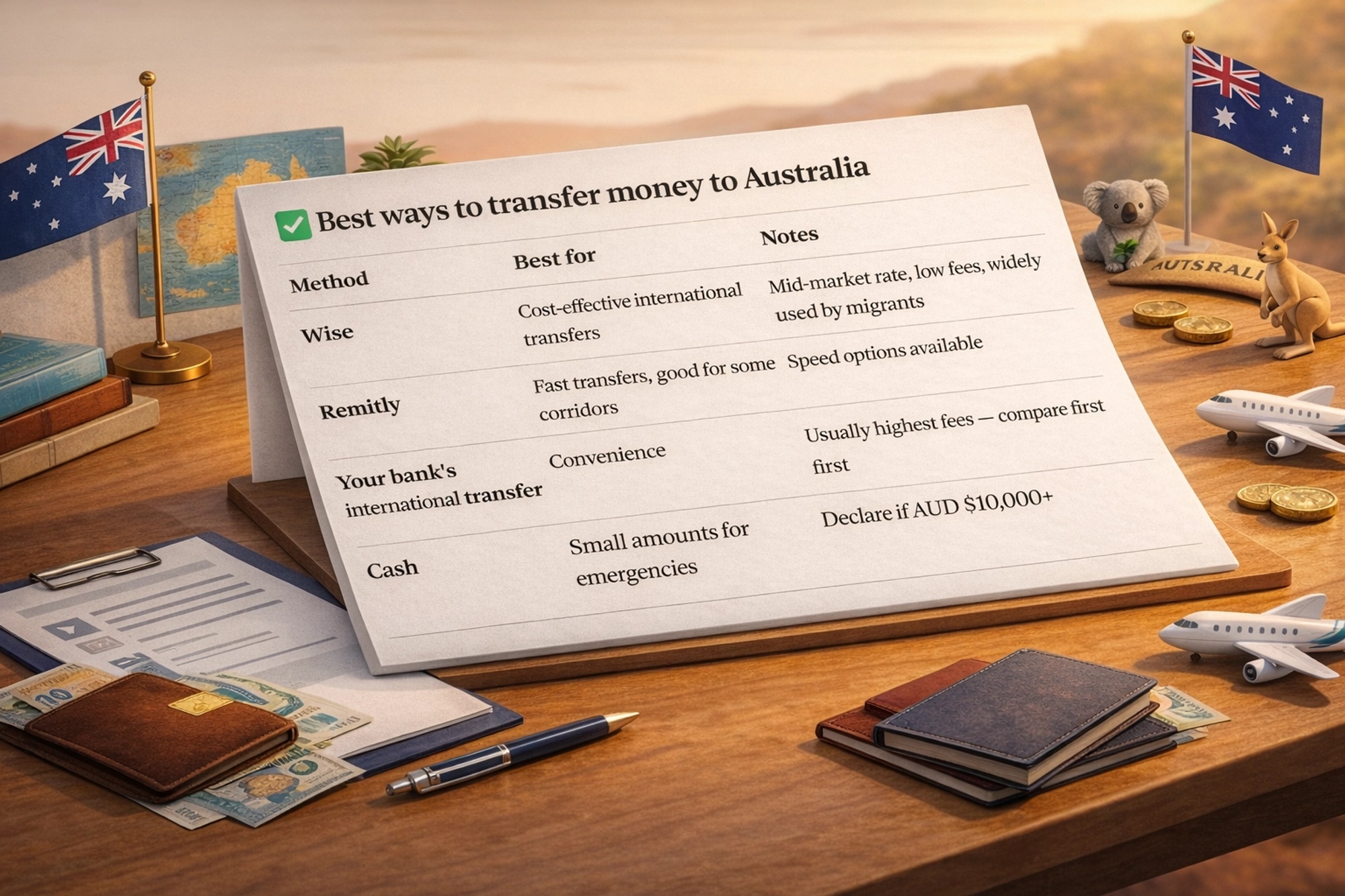
SettleMate's Tip: SettleMate recommends transferring funds to your pre-opened Australian bank account before you depart — not waiting until you land. This means you have money accessible from Hour 1 in Australia. Avoid airport currency exchange booths, which typically offer some of the worst rates you'll find anywhere.
✅ Get a travel card for the gap period
If your debit card won't arrive before you leave, consider a Wise card or similar multi-currency card that works in Australia. These let you hold AUD, withdraw from ATMs, and make card payments without the 3% foreign transaction fees that most home-country bank cards charge.
📱 Step 5: Research Your Australian SIM Card
You will need an Australian SIM card on the day you land — for maps, for Uber, for calling your landlord, for banking authentication. Don't wait until you're at the airport.
✅ Main options for new arrivals
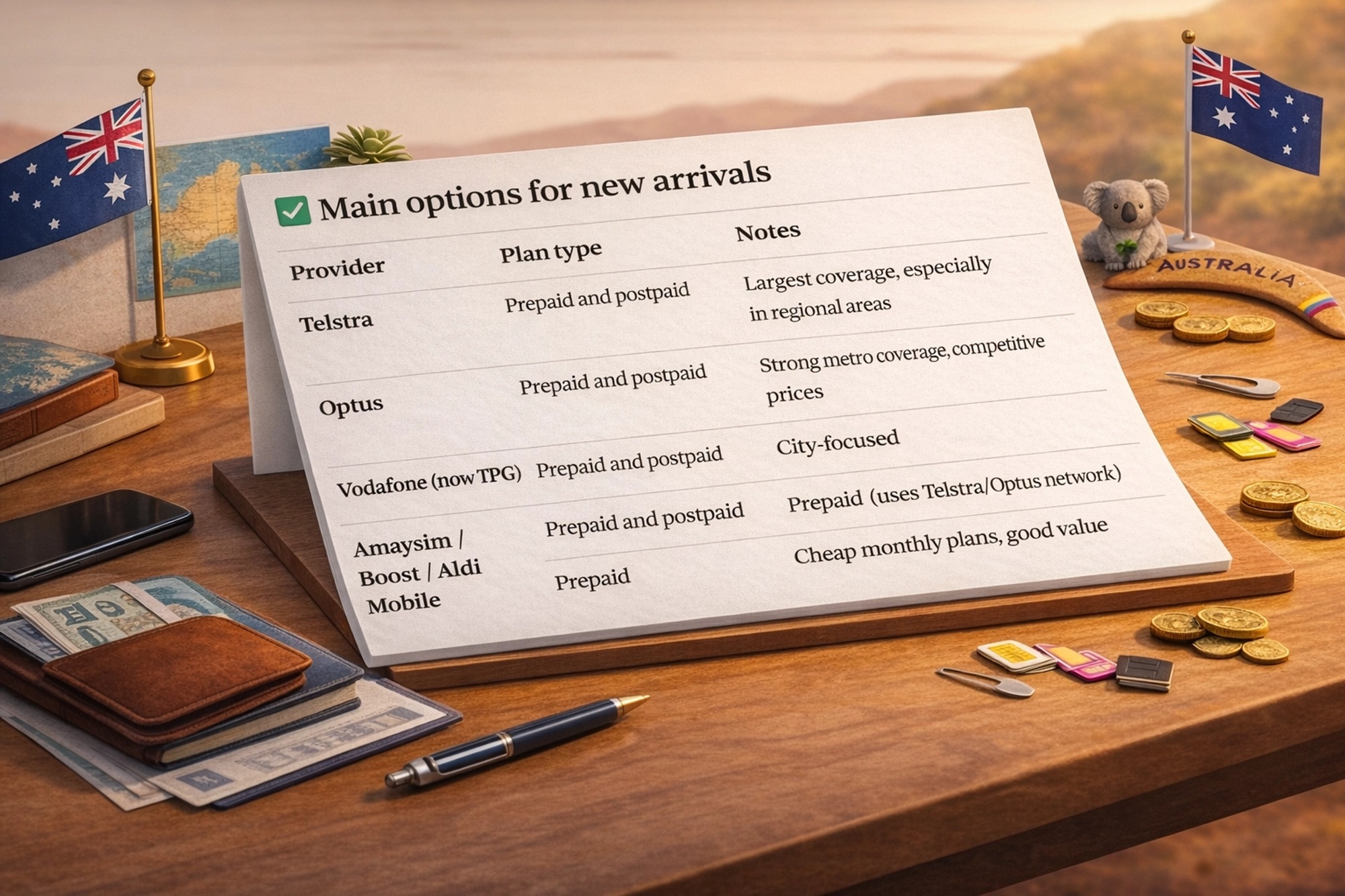
For new arrivals without a fixed address, prepaid SIM cards are the easiest option. You can buy them at airport terminals, convenience stores (7-Eleven, news agencies), or major supermarkets. Bring your passport — you'll need to register the SIM with ID.
✅ Keep your home country number active
Keep your home SIM active during the first few weeks. You may need it for two-factor authentication with your home country banks or government services. A cheap international roaming add-on from your home provider is worth it for the first month.
SettleMate's Tip: SettleMate recommends researching SIM card options before you land and deciding on a provider so you don't waste time at the airport. Airport SIM card kiosks are convenient but often priced higher than in-city stores. If you know you'll land in Sydney, Melbourne, Brisbane, Perth, or Adelaide, there's a Telstra or Optus store very close to every international terminal.
🏠 Step 6: Secure Your First Accommodation and Know Your Rental Basics
Australia's rental market is competitive, particularly in Sydney, Melbourne, and Brisbane. You need to know the lay of the land before you arrive.
✅ Temporary accommodation for Week 1
You should have at least your first 1–2 weeks of accommodation confirmed before you board. Options include:
- Student residence / university accommodation — If you're on a student visa, your university often provides short-term housing for new students. Confirm availability well in advance.
- Short-stay serviced apartments — More space and kitchen access than hotels. Good for first 2–4 weeks.
- Airbnb — Flexible for short stays but can be expensive for extended periods.
- Share houses / hostels — Budget-friendly. Websites like Gumtree, Facebook Marketplace, and Flatmates.com.au are used to find share house rooms.
Important: You must have an accommodation address to write on your Incoming Passenger Card when you land. This cannot be left blank.
✅ What to know about renting in Australia before you start
Even if you won't be signing a lease in the first week, start learning how Australian renting works now so you're not caught off-guard:
- Bond: A bond (security deposit) is typically 4 weeks' rent, paid to the Rental Bond Authority in your state before moving in. It is held by a government body, not the landlord.
- Lease agreements: Standard leases are 12 months in Australia. Short-term leases exist but are less common.
- References: Landlords and real estate agents expect 2–3 references. Without Australian rental history, international students and new arrivals often need to provide employment contracts, university offers, or bank statement evidence of financial capacity.
- Applications: Most rentals in Australia use online platforms (realestate.com.au, domain.com.au) and applications submitted through those platforms.
SettleMate's Tip: SettleMate consistently sees new arrivals struggle with rental applications because they lack Australian rental history. SettleMate recommends having the following ready before applying for any rental: a copy of your visa grant, a bank statement showing funds (even from overseas), your employment contract or university CoE, and at least two professional or character references. Some agents will accept an international reference if it's from an employer or institution.
🟧 WEEK 3 (Days 14–8): Packing, Biosecurity and Logistics
This week is about getting physically ready to depart — and avoiding costly mistakes at the Australian border.
🚫 Step 7: Learn Australia's Biosecurity Rules (This Is Not Optional)
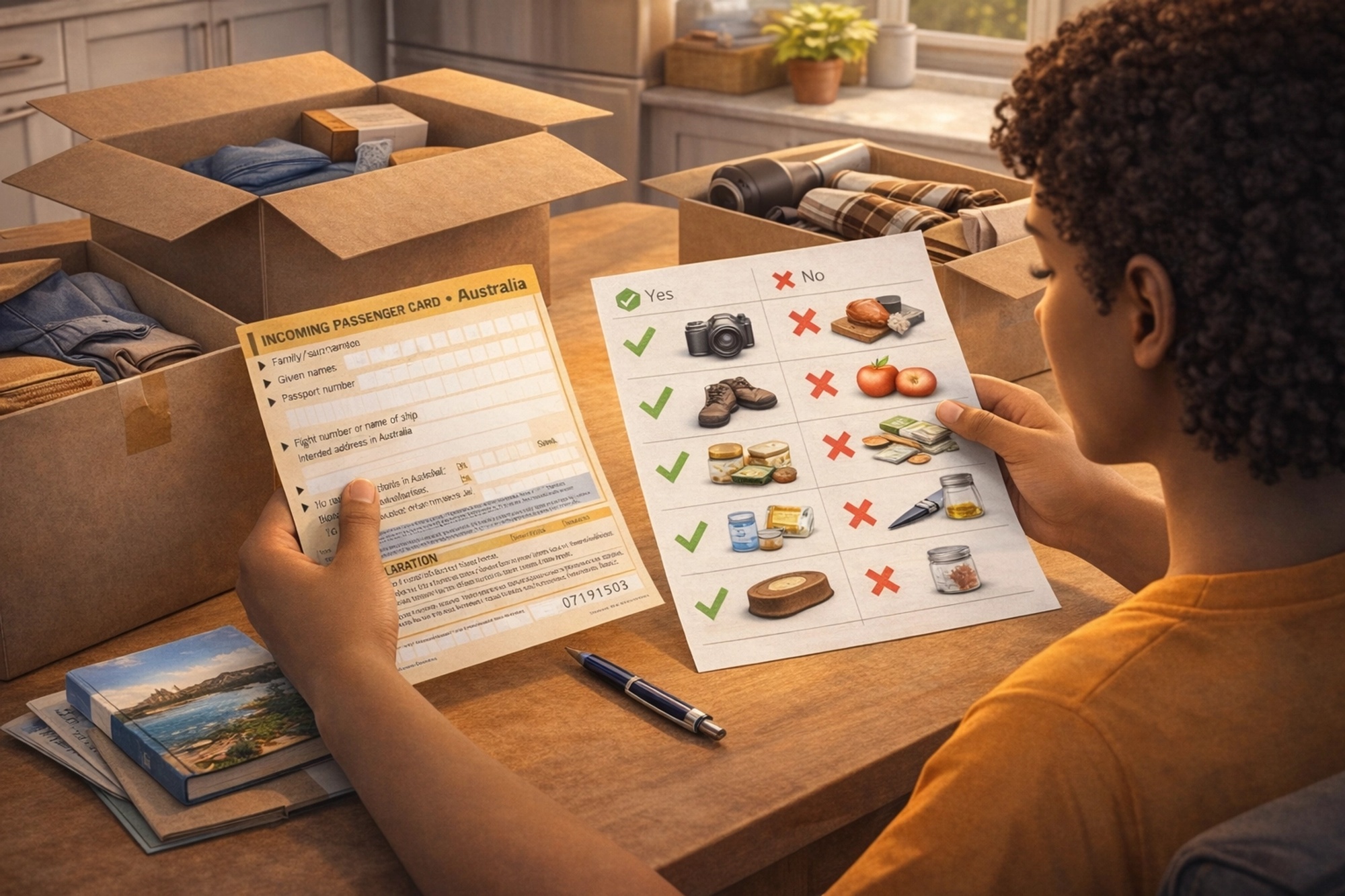
Australia has some of the strictest biosecurity and customs laws in the world. This is not bureaucratic inconvenience, it's active enforcement with significant penalties. Getting this wrong can delay your arrival, result in heavy fines, or in serious cases, affect your visa.
✅ What you MUST declare on your Incoming Passenger Card
When you land in Australia, you'll complete an Incoming Passenger Card (IPC), either on paper (handed out on the plane) or potentially via a digital pilot on certain flights. You must truthfully declare:
- ✅ All food, plant material, and animal products (including honey, seeds, spices, fresh and dried foods)
- ✅ Firearms, weapons, and ammunition (including replicas)
- ✅ Cash or cash equivalents of AUD $10,000 or more (or the foreign equivalent)
- ✅ Medicines (if you're carrying more than a personal-use quantity, or certain prescription medications)
- ✅ Soil, sand, or items with dirt on them (outdoor shoes, sports equipment, gardening tools)
✅ What you CANNOT bring into Australia
- ❌ Fresh fruit, vegetables, and plants
- ❌ Fresh or unprocessed meat, poultry, pork, eggs, and most dairy products
- ❌ Live animals and birds without prior permission
- ❌ Illegal drugs of any kind
- ❌ Weapons and firearms without proper permits
- ❌ Items made from wildlife (coral, ivory, hunting trophies) without CITES permits
✅ The golden rule of Australian biosecurity
When in doubt — declare it. Declaring an item does not mean it will be confiscated. A biosecurity officer will inspect it and in most cases return it to you. Failing to declare a restricted item, even accidentally, can result in on-the-spot fines of up to AUD $6,600, and serious deliberate breaches can lead to visa cancellation, a re-entry ban, or prosecution.
If you're shipping goods to Australia separately from your luggage (for example, household items), you'll need to complete a B534 Unaccompanied Personal Effects Statement and ensure all outdoor items are clean and free from soil.
SettleMate's Tip: SettleMate recommends doing a "biosecurity check" of your luggage 1–2 weeks before departure — not the night before. Go through everything you plan to bring and ask: is this food, a plant product, or could it have soil on it? If your hiking boots have been used outdoors, clean them thoroughly. If you're bringing herbal medicines, check their status with the Australian Border Force (abf.gov.au). A single undeclared item can turn your first day in Australia into an hours-long delay.
🧳 Step 8: Pack Smart for Australia
✅ Document organiser — carry-on essentials
Create a physical folder or document wallet for your carry-on with the following:
- ☐ Passport (original)
- ☐ Visa grant letter (printed)
- ☐ OSHC/OVHC insurance certificate
- ☐ CoE (student visa holders)
- ☐ Employment contract or sponsorship letter (as applicable)
- ☐ First night accommodation confirmation
- ☐ Bank account details (BSB + account number)
- ☐ Emergency contact numbers (printed — don't rely only on your phone)
- ☐ Blank Incoming Passenger Card (optional — most airlines distribute these onboard)
✅ Australia-specific packing essentials
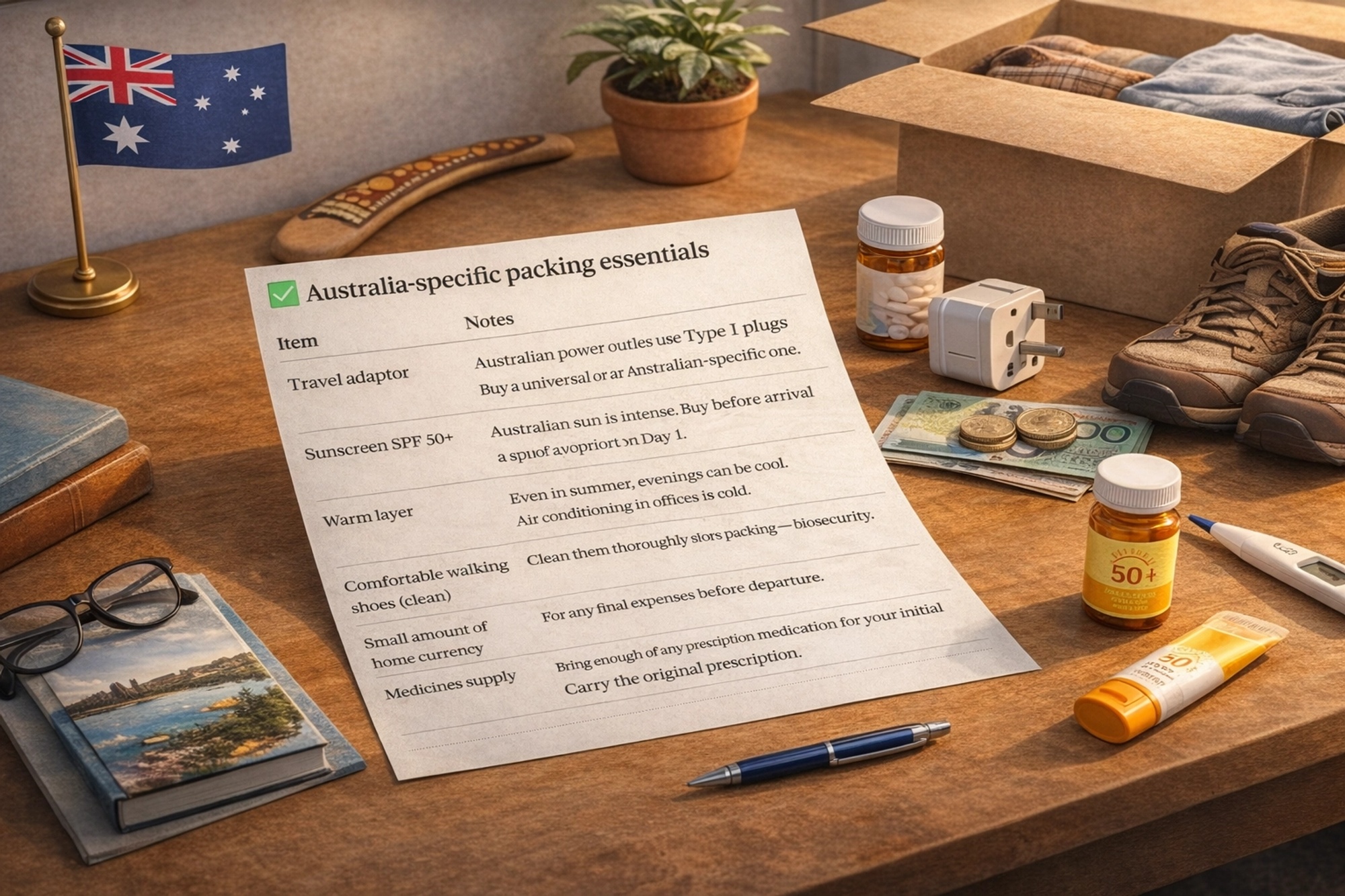
SettleMate's Tip: SettleMate recommends keeping your luggage weight at least 2kg under your airline's limit. On arrival you may receive mail, documents, or small purchases in your first week that you'll want to carry. More importantly, if border officers ask you to open your luggage, a tidy and organised bag goes through much faster than an overstuffed one.
🟥 FINAL PUSH (Days 7–1): The Last Stretch
🔍 Step 9: Complete Your Final Admin and Preparation

✅ Confirm your travel bookings
- Flight confirmed and checked in (online check-in opens 24–48 hours before departure for most airlines)
- Accommodation for nights 1–7 confirmed with booking references saved
- Airport transfer or public transport route from airport to accommodation researched
- Transit visas arranged if your route passes through another country (e.g. stopover in the UAE, Singapore, or Malaysia — check visa requirements for each country you transit)
✅ Notify key parties of your move
- Bank(s) in your home country — notify them you're going abroad to avoid your cards being blocked
- Tax authorities in your home country — you may have ongoing obligations depending on your country
- Employer (if you're leaving a job) — confirm any final payments, superannuation, or outstanding entitlements
- Healthcare providers — get prescriptions filled for at least 3 months, carry original scripts
✅ Online accounts and digital preparation
- Download the myID app (formerly myGovID) — Australia's digital identity service, used to verify yourself for ATO and government services. Download it before you leave and begin the setup.
- Create a myGov account at my.gov.au — you'll link this to your ATO and Medicare accounts after arrival
- Download your bank's app and confirm your login works
- Save offline maps of your arrival city (Google Maps allows offline downloads)
- Download translation apps if English isn't your first language — Google Translate works offline with downloaded language packs
SettleMate's Tip: SettleMate recommends downloading the myID app and beginning your myGov setup before departure, even if you can't fully complete it until you have an Australian address. Having a head start means you can get your TFN and Medicare enrollment done in your first week rather than your first month. The ATO's TFN application for migrants (via the Individual Auto Registration system, IAR) requires you to be physically in Australia, but having myGov ready means you can move immediately.
🧾 Step 10: Understand What Happens at the Australian Border
Knowing what to expect at arrival takes the anxiety out of it. Here's the exact process.
✅ The arrival sequence at Australian airports
Step 1 — Disembark Staff will direct you from the aircraft to the arrivals terminal. Follow the signs for "Arrivals" and "Immigration."
Step 2 — Complete your Incoming Passenger Card (IPC) If you haven't filled this in on the plane, there are counters in the terminal. Fill it in honestly and completely.
Step 3 — Immigration clearance
- If you hold an eligible ePassport, you may be directed to the SmartGate — Australia's automated border processing system. It's quick and straightforward.
- Otherwise, present your passport and completed IPC to an immigration officer.
- Officers may ask basic questions: Where will you be staying? How long are you here for? Do you have enough funds?
Step 4 — Collect your baggage
Step 5 — Biosecurity and customs declaration Hand your IPC to the biosecurity officer. All bags pass through x-ray screening. Declare everything you're unsure about — it is always better to declare.
Step 6 — You're in Australia!
SettleMate's Tip: SettleMate recommends reading your Incoming Passenger Card carefully before you fill it in — not rushing through it while tired on the plane. The biosecurity questions ask about food, plant material, animal products, and soil. If you're carrying any food items, even packaged ones, the safest approach is to declare them. Officers assess the risk — in most cases, low-risk items are returned to you. The declaration is not an admission that you've done something wrong. It's doing the right thing.
💡 Money-Saving Tips for Pre-Departure
- Transfer money before you leave, not at the airport. Airport forex booths charge the worst rates. Wise or Remitly are significantly cheaper for international transfers.
- Open your CommBank account now — up to 14 days before departure. Arriving with an active account saves you a branch visit on a busy first day.
- OSHC is mandatory for students, not optional. Don't try to save money by going without or purchasing cheaper international travel insurance that doesn't meet OSHC requirements. Your visa can be cancelled.
- Pack clean shoes. Bringing dirty outdoor shoes through Australian biosecurity means they'll be inspected, possibly cleaned at your expense, or destroyed. Clean them before packing.
- Keep your home bank account open. You may need it for any final payroll payments, refunds, or to receive money from family before your Australian account is fully active.
- Buy travel insurance separately from health insurance. Your OSHC or OVHC does not cover lost luggage, flight delays, or travel disruptions. A separate travel insurance policy for the journey itself is worth the small cost.
📌 Official & Trusted Resources
This guide is informed by the following official Australian government sources:
- Department of Home Affairs: immi.homeaffairs.gov.au — visa conditions, VEVO, and border entry
- Australian Taxation Office: ato.gov.au — TFN applications, tax residency, IAR system
- Services Australia: servicesaustralia.gov.au — Medicare eligibility and enrolment
- Australian Border Force: abf.gov.au — biosecurity, customs, and what to declare
- Study Australia (Government): studyaustralia.gov.au — student pre-departure guidance
- Smartraveller: smartraveller.gov.au — biosecurity and border controls
DISCLAIMER
This guide is provided for general informational purposes only. While SettleMate strives to keep all information accurate and up to date, requirements and processes may change and can vary by individual circumstances or state and territory. This content does not constitute legal, tax, migration, or financial advice. SettleMate is not a registered migration agent. Always verify important details through official Australian government sources or seek advice from a qualified professional. For visa and migration matters, consult a registered migration agent (MARA agent).
SHARING & USAGE
This guide is original content created by SettleMate. You are welcome to share, link to, or quote this guide for personal, educational, or non-commercial purposes, provided SettleMate is clearly credited as the source. ©SettleMate. All rights reserved.
settlemate.au
Made with ❤️ for immigrants in Australia
Let's chat like humans, not forms
Answer a few quick questions and we'll route your note to a certified expert, no matter where you are in the world.
SettleMate Response Promise
Every conversation is reviewed by a specialist within 24 hours (often much sooner), and you'll always get a personalised next step.
- Thoughtfully reviewed by a real specialist.
- Personalized replies tailored to your unique situation.
- Actionable next steps, delivered clearly after each consultation.
Need something faster?
Reach us directly
Prefer a quick reply? Use any of the touchpoints below and our concierge team will jump in.