Guide
Australian Tax Guide for Migrants: TFN, Residency & Filing
Tax in Australia works very differently from most countries — and the consequences of getting it wrong are real. This guide explains everything a migrant needs to know to feel genuinely confident at tax time: what your tax residency status actually means and how the ATO determines it, how Australia's progressive tax brackets work in plain English, the critical role of your TFN, how superannuation works from Day 1, what temporary residents are taxed on, and how to lodge your first Australian tax return correctly.
- A Tax File Number (TFN) — apply free at ato.gov.au the moment you arrive
- A myGov account linked to the ATO — set up at my.gov.au
- Your income statement from your employer (available in myGov from mid-July each year)
- Records of any deductions you intend to claim
- Your bank interest statements and any investment income details
- All migrants arriving in Australia — permanent and temporary visa holders
- Subclass 500 — International Students
- Subclass 482 — Temporary Skill Shortage workers
- Subclass 485 — Graduate Temporary visa holders
- Subclass 189 / 190 / 491 — Skilled visa holders (permanent and provisional)
- Subclass 417 / 462 – Working Holiday Maker
- Subclass 820 / 309 — Partner visa holders
- Anyone lodging their first Australian tax return
Key topics covered
About SettleMate
SettleMate is an Australian settlement platform that helps new migrants, international students, and visa holders move to Australia with confidence using step-by-step guides and practical checklists.
This guide is part of SettleMate’s official settlement resources, created from real migrant experiences and current Australian requirements.
Australian tax guide for migrants: what you need to know
Tax is one of the topics that causes the most anxiety for new migrants to Australia and understandably so. The rules are unfamiliar, the terminology is different, and the consequences of getting things wrong can be financially significant. Migrants are taxed at the highest possible rate if they don't have a TFN. They can miss out on thousands of dollars in refunds by not lodging a return. They can unknowingly be paying the wrong amount of tax because their residency status was never properly established.
The good news is that Australian tax, once understood, is genuinely fair and logical. Australia uses a progressive tax system with a meaningful tax-free threshold for residents. Superannuation — Australia's compulsory retirement savings system is paid on top of your salary, not deducted from it. And the ATO's myTax system makes lodging your own tax return straightforward for most migrants.
This guide, put together by SettleMate, covers everything you need to understand and feel confident about Australian tax: how the ATO determines your tax residency, what the 2025–26 tax brackets mean in plain English, the role of your TFN, how superannuation works from Day 1, what temporary residents and working holiday makers are taxed on, what deductions you can claim, and how to lodge your first Australian tax return.
📋 What This Guide Covers

- The Australian financial year — how it works
- Tax residency — the ATO's four tests and why they matter
- The three tax categories — resident, temporary resident, non-resident
- Working holiday makers — special tax rules for 417 and 462 visa holders
- Your Tax File Number (TFN) — what it is and why it's urgent
- The 2025–26 income tax brackets explained in plain English
- PAYG withholding — how tax is collected from your pay
- Superannuation — how Australia's compulsory retirement system works for migrants
- The Medicare levy — what you pay and who is exempt
- What you can deduct — common tax deductions for migrants
- How to lodge your Australian tax return
- The tax return deadline — when to lodge and what happens if you're late
- Money-saving tips
📅 STEP 1: The Australian Financial Year — How Time Works for Tax
🗓️ Understanding the Tax Calendar

The single most important thing to understand about Australian tax is that the financial year does not run from January to December. In Australia, the financial year runs from 1 July to 30 June. This is different from most countries and catches many new migrants by surprise.
What this means in practice:
- 1 July 2025 to 30 June 2026 is the current financial year (FY2025–26)
- Your employer withholds tax from every pay throughout this period
- From 1 July 2026, you can lodge your tax return for FY2025–26
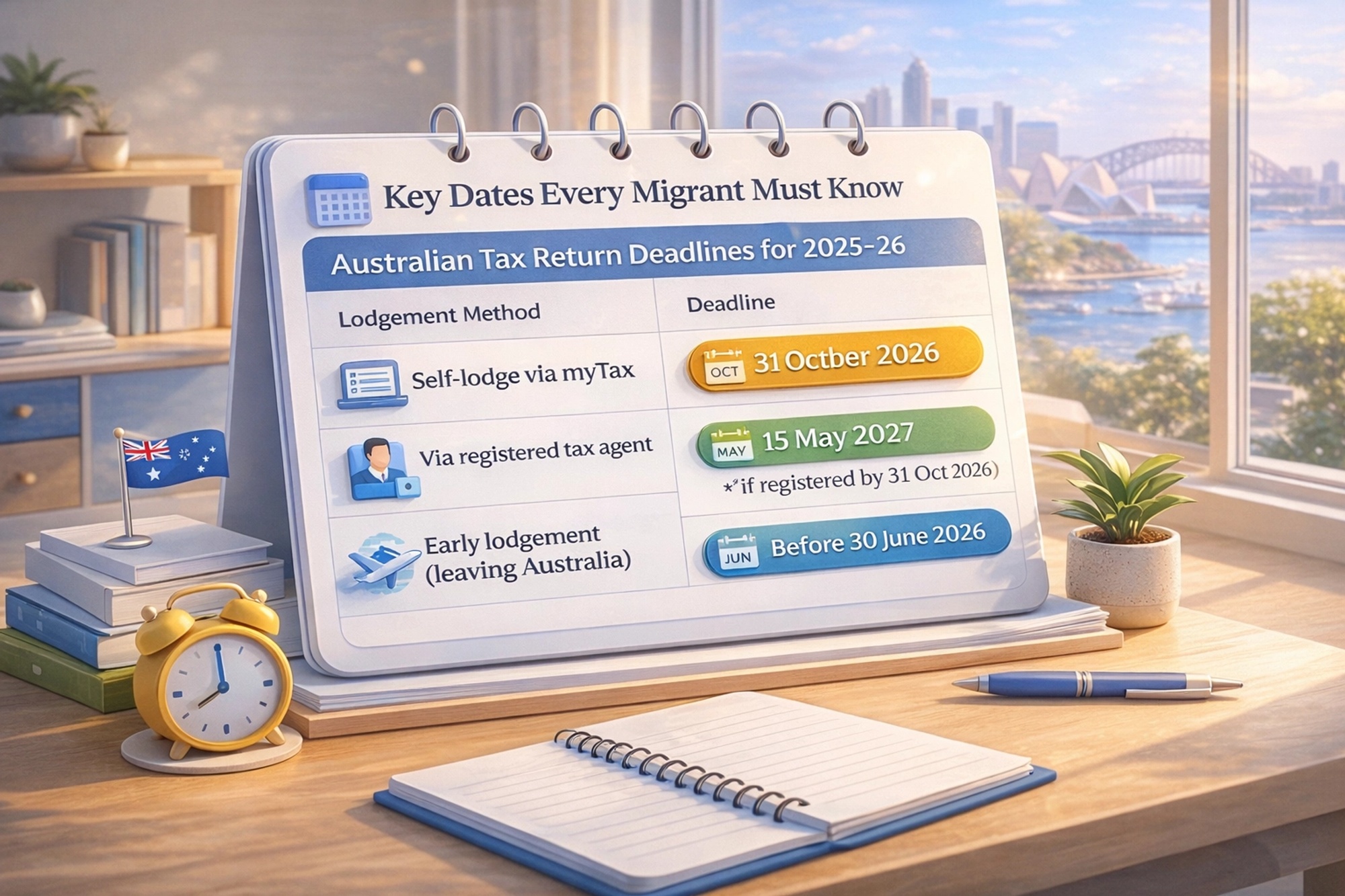
- The self-lodgement deadline is 31 October 2026
- If you use a registered tax agent, you may get an extension until 15 May 2027
The end-of-financial-year (EOFY) — 30 June — is one of the most important dates in Australia's economic calendar. Retailers hold EOFY sales, businesses finalise accounts, and tax planning decisions need to be made before this date to apply to the current year.
For migrants who arrive mid-year, your first tax return will cover only the portion of the year you were in Australia and earning Australian income. You are not liable for the full financial year if you only arrived part-way through.
SettleMate's Tip: SettleMate recommends marking 30 June and 31 October in your calendar on the day you arrive. EOFY (30 June) is when the financial year closes — any deductible purchases, super contributions, or tax planning decisions must happen before this date to count. 31 October is the lodgement deadline. Missing either date has financial consequences. Set reminders from Day 1.
🏛️ STEP 2: Tax Residency — The ATO's Four Tests and Why They Matter
🔍 Are You a Tax Resident of Australia?

This is the question most migrants don't think to ask and it's the most consequential tax question you will face. Your tax residency status determines what income Australia can tax you on, what tax rates apply, and whether you can access the tax-free threshold.
Critical distinction: Your tax residency status is completely separate from your immigration visa status. You can be on a temporary visa and still be an Australian tax resident. You can be on a permanent resident visa and still be a non-resident for tax purposes in some circumstances. The ATO uses its own tests, independent of the Department of Home Affairs.
The ATO applies four tests to determine tax residency. Passing any one is sufficient to be classified as an Australian tax resident:
✅ Test 1: The Resides Test (Primary Test)
This is the main test. It asks: do you live in Australia as part of your regular lifestyle? The ATO considers factors including:
- Whether you have set up a home in Australia
- How long you have been in Australia and your intention to stay
- Where your family and personal effects are located
- Your employment or business ties in Australia
- Your social and economic ties
For most migrants who arrive in Australia, rent accommodation, open a bank account, start a job, and establish a routine, you will pass the Resides Test and be an Australian tax resident from the date you arrive. You do not need to be a permanent resident to pass this test.
✅ Test 2: The Domicile Test
If your permanent home (domicile) is Australia, you are an Australian tax resident, even if you are temporarily overseas. This test applies mainly to Australians who leave temporarily, not to incoming migrants.
✅ Test 3: The 183-Day Test
If you spend 183 days or more in Australia during the financial year, you will generally be treated as a tax resident. Note that spending fewer than 183 days does not automatically make you a non-resident the ATO also considers the other tests.
✅ Test 4: The Commonwealth Superannuation Test
Applies only to Australian Government employees working overseas who are members of the Commonwealth Superannuation Scheme (CSS) or Public Sector Superannuation Scheme (PSS). Generally not relevant for most migrants.
The practical implication for most migrants: If you arrive in Australia, rent accommodation, open bank accounts, and start working, you are almost certainly an Australian tax resident from your arrival date, regardless of what visa you hold. This means:
- You pay tax on Australian-sourced income at resident rates
- You receive the tax-free threshold ($18,200 for FY2025–26)
- If you are a temporary resident (see Step 3), most of your foreign income is exempt
SettleMate's Tip: SettleMate strongly recommends against assuming your tax residency status based on your visa type alone. Temporary skilled workers (482), international students (500), graduate visa holders (485), and working holiday makers (417/462) can all potentially be tax residents or non-residents depending on their circumstances. The ATO's residency tool at ato.gov.au and a qualified registered tax agent are the right places to verify your specific situation — especially in your first year.
📊 STEP 3: The Three Tax Categories — Resident, Temporary Resident, Non-Resident
🗂️ Which Category Applies to You?

Once your tax residency is established, there are three tax categories that apply to individuals in Australia:
🟢 Category 1: Australian Tax Resident (Not a Temporary Resident)
This applies to: Australian citizens, permanent residents, and migrants who have become permanent residents and no longer hold a temporary visa.
Tax treatment:
- Taxed on worldwide income — all income from anywhere in the world must be declared on your Australian tax return
- Entitled to the tax-free threshold ($18,200 for FY2025–26)
- Pays the Medicare levy (2% of taxable income)
- Accesses the Low Income Tax Offset (LITO) and other resident offsets
🟡 Category 2: Australian Tax Resident — Temporary Resident
This is the category that applies to most working migrants in Australia. A temporary resident for tax purposes is someone who:
- Holds a temporary visa (not a permanent visa), AND
- Is an Australian tax resident under one of the four tests above, AND
- Neither you nor your spouse is an Australian citizen or permanent resident
Tax treatment — the important difference:
- Taxed on Australian-sourced income at resident rates (including the tax-free threshold)
- Most foreign-sourced income is EXEMPT — you do not pay Australian tax on income from overseas investments, interest in foreign bank accounts, or most foreign passive income
- Capital gains on non-Australian assets are generally exempt — if you sell shares in a foreign company or a property overseas, that gain is generally not taxable in Australia while you are a temporary resident
- Does pay the Medicare levy if eligible for Medicare; otherwise can claim exemption
- Foreign employment income may be taxable even as a temporary resident — if you do work overseas while living in Australia, that income may be assessable in Australia
This is one of the most valuable and least-understood tax concessions available to migrants. If you have investment income from your home country — bank interest, dividends, rental income from a property overseas — it is generally not taxable in Australia while you hold a temporary visa and are a temporary resident for tax purposes.
🔴 Category 3: Foreign Resident (Non-Resident for Tax Purposes)
This applies to: visitors, people who do not establish sufficient ties to Australia, and some short-term workers who do not pass any of the four residency tests.
Tax treatment:
- Taxed on Australian-sourced income only
- No tax-free threshold — taxed from the first dollar at 30% up to $135,000
- No access to the LITO or most resident tax offsets
- Does not pay the Medicare levy (and can claim exemption on tax return)
- Interest on Australian bank accounts taxed at withholding rate (10% if overseas address provided)
SettleMate's Tip: SettleMate has seen migrants on temporary visas (482, 485, 500) overpay significant amounts of tax because they incorrectly treated themselves as non-residents when they were actually temporary residents with access to resident tax rates and the tax-free threshold. If you are living and working in Australia full-time, you are almost certainly an Australian tax resident — and the difference in tax rates between resident and non-resident treatment is very large. If you are unsure, seek advice from a registered tax agent in your first year.
🎿 STEP 4: Working Holiday Makers — Special Tax Rules for 417 and 462 Visas
⚡ The Backpacker Tax Explained
Working holiday makers (subclass 417 and 462 visas) are taxed under a completely separate and specific tax regime, regardless of their residency status.
2025–26 Tax Rates for Working Holiday Makers:
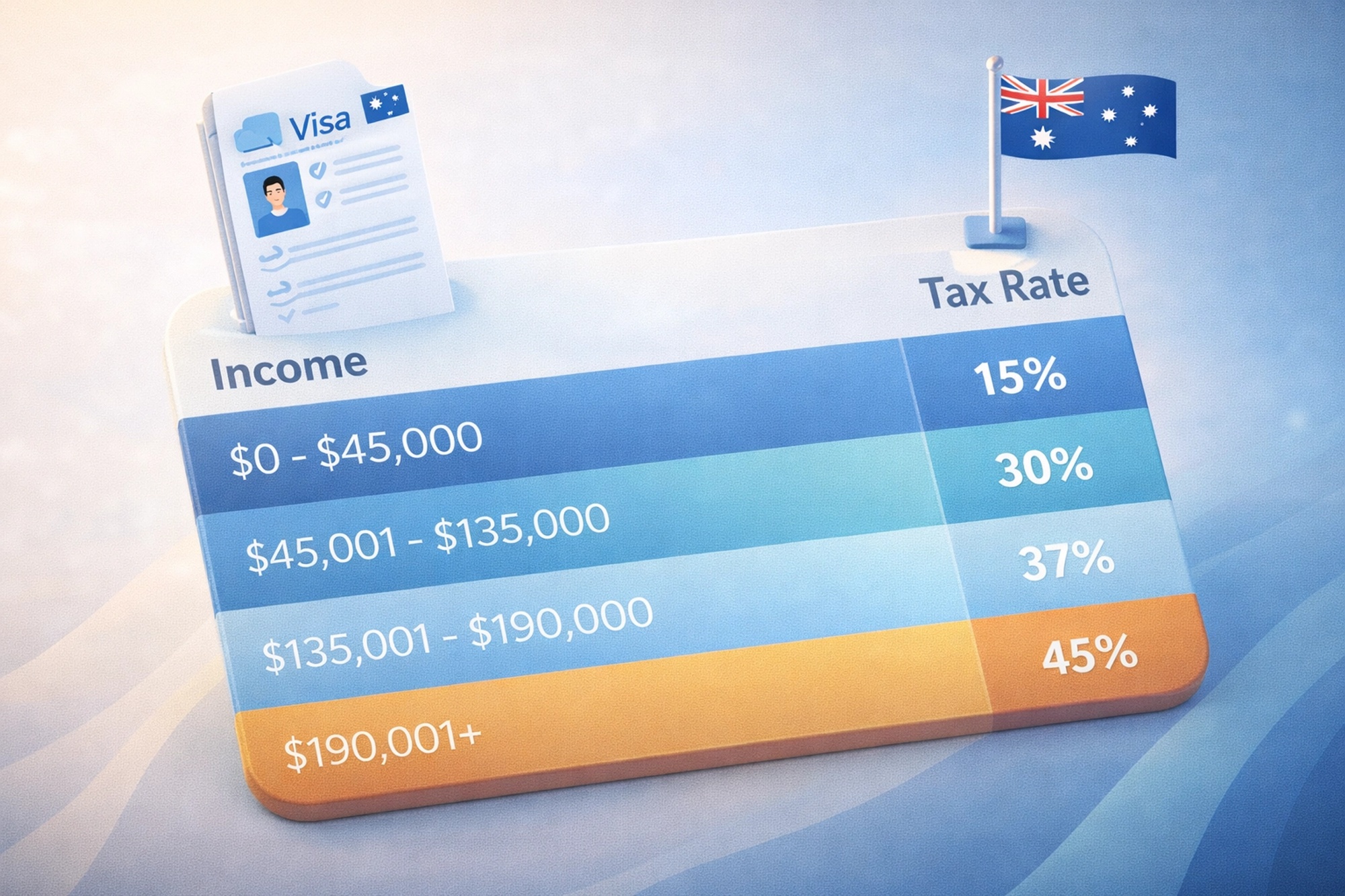
Key points for working holiday makers:
- No tax-free threshold. Unlike Australian residents who pay 0% on the first $18,200, WHMs pay 15% from the very first dollar earned.
- No Medicare levy. Most WHMs are non-residents for tax purposes and are not eligible for Medicare, so the 2% Medicare levy does not apply.
- Your employer must be registered as a WHM employer with the ATO for the 15% rate to apply. If they are not registered, they must withhold at the non-resident rate of 30% from the first dollar. This results in significant over-withholding that you can recover by lodging a tax return.
- Always tell your employer you are on a 417 or 462 visa when you start work so they apply the correct rate.
- Superannuation applies — working holiday makers are entitled to super contributions at the 12% rate if they are eligible employees.
- You can claim your super back when you leave Australia permanently through the Departing Australia Superannuation Payment (DASP) scheme. Note: DASP for WHMs is taxed at 65% — this is the "backpacker tax on super" and is a significant reduction.
SettleMate's Tip: SettleMate recommends every working holiday maker check whether their employer is registered as a WHM employer at ato.gov.au before their first pay day. If they're not registered, the tax withheld from your pay will be significantly higher than it should be. You can recover the excess by lodging a tax return, but it requires you to track and claim it — and many WHMs leave Australia without ever getting money they were owed. Fifteen minutes of checking can protect hundreds of dollars.
🪪 STEP 5: Your Tax File Number (TFN) — What It Is and Why It's Urgent
🧾 Getting Your TFN Right

A Tax File Number (TFN) is your unique nine-digit personal identifier in the Australian tax and superannuation systems. It is yours for life — you keep the same TFN even if you change jobs, change your name, or leave and return to Australia.
Why your TFN is financially urgent:
Without a TFN on file:
- Your employer must withhold 47% from your wages (the top marginal rate including Medicare levy)
- Your bank must withhold 47% from any interest your account earns
- Your superannuation fund may be charged a significantly higher tax rate on contributions
This is the single most expensive administrative mistake new migrants make. A migrant on $70,000 without a TFN effectively hands over $32,900 in withholding tax to the ATO instead of the correct ~$14,000. The excess is recoverable when you lodge a tax return, but you lose the money's value for the entire time the ATO holds it.
It is free to apply for a TFN. Any website charging a fee to help you apply is not the ATO and is potentially a scam.
✅ How to Apply for Your TFN as a Migrant
Online — for permanent migrants and temporary visitors with work rights:
Migrants in Australia who hold a valid visa with work rights can apply online using the ATO's Individual Auto Registration (IAR) system:
Go to ato.gov.au and navigate to: Individuals → Tax file number → Apply for a TFN → Foreign passport holders, permanent migrants and temporary visitors
You must already be in Australia to apply online
Have your passport and Australian address ready
The application takes approximately 20 minutes
Your TFN is mailed to your Australian address within 28 days
Important:
- You must have a work rights visa linked to your passport to use the online IAR system
- If your visa does not include work rights, you will need to use a paper application form (NAT 2628)
- New Zealand citizens can use the same online process
- Do not lodge more than one application — duplicates delay processing
✅ What to Do Once Your TFN Arrives
- Give your TFN to your employer on your Tax File Number Declaration form
- Add your TFN to your bank account (bank app → settings → tax information)
- Add your TFN to your superannuation fund
- Link your myGov account to the ATO (requires your TFN)
SettleMate's Tip: SettleMate recommends applying for your TFN on the day you arrive or within the first 48 hours. The 28-day wait is unavoidable — but if you delay your application by two weeks, you are waiting four weeks total. Your employer can accept you starting work while your TFN is pending — just inform them "I've applied and will provide my TFN within 28 days." Keep your application receipt ID safe as proof.
💰 STEP 6: The 2025–26 Income Tax Brackets Explained in Plain English
📊 How Australia's Progressive Tax System Works

Australia uses a progressive tax system — meaning you pay higher rates only on the portion of your income that falls within each bracket. You do not pay the higher rate on your entire income when you cross a threshold.
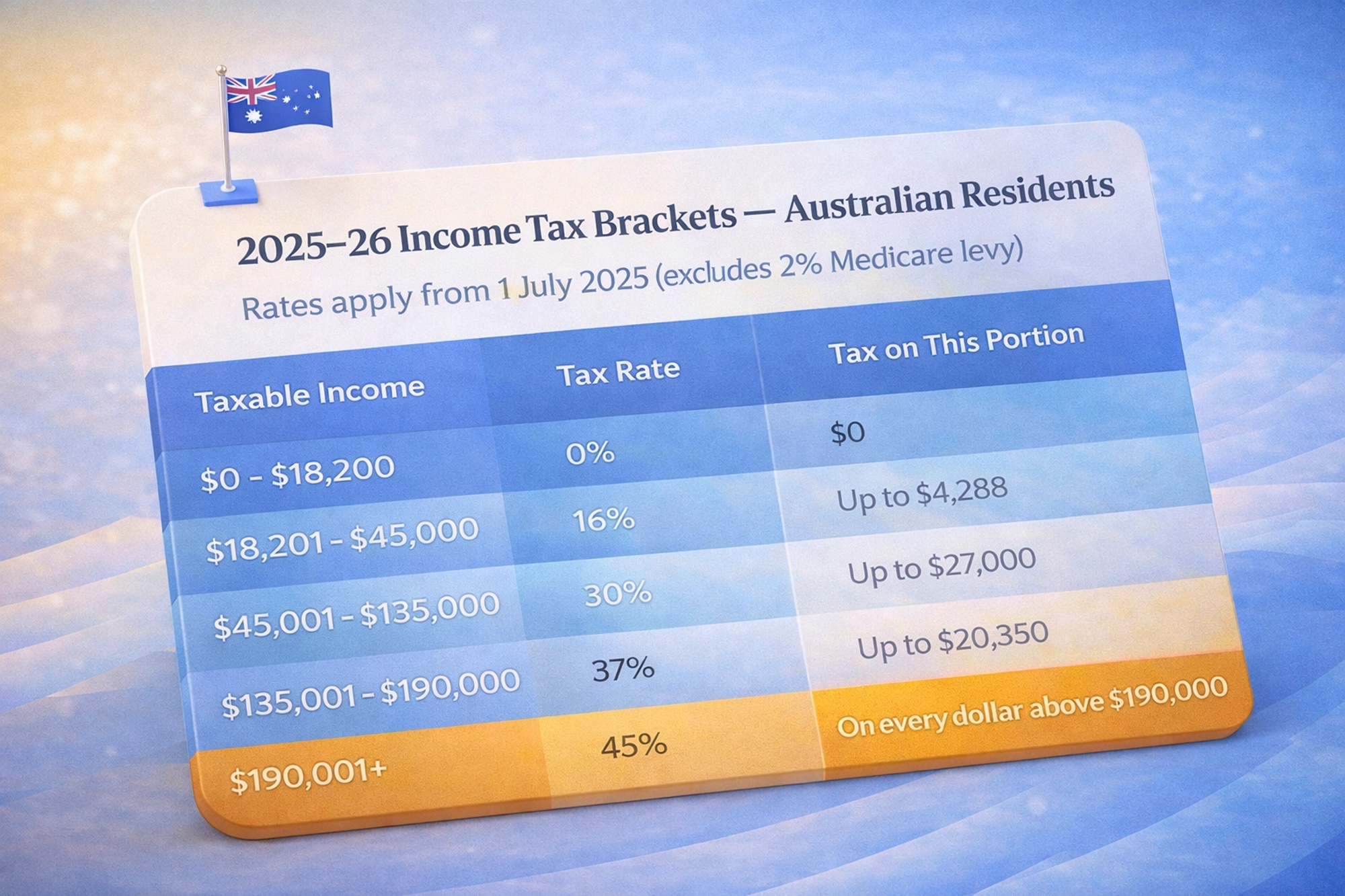
How progressive tax actually works — the most common misconception:
Many migrants are alarmed when they see they are in the "30% bracket." They fear 30% will be taken from their entire income. This is wrong. Here is how the brackets actually work for a migrant earning $80,000 per year:
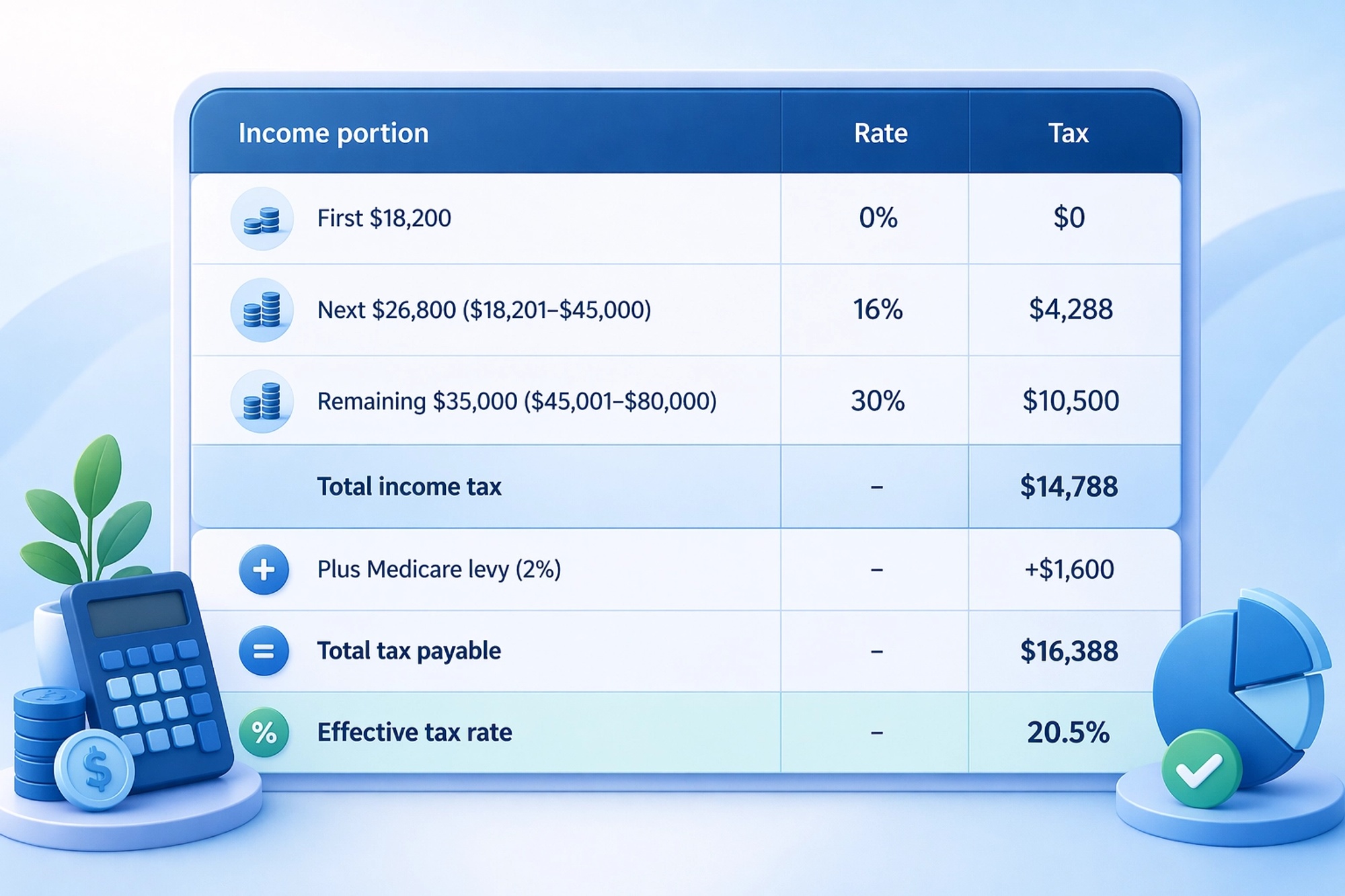
The effective tax rate (20.5%) is significantly lower than the marginal rate (30%). Your marginal rate is the rate applied to your last dollar of income — not your total income.
✅ The Tax-Free Threshold — $18,200
Australian tax residents are entitled to earn up to $18,200 per year completely tax-free. This is called the tax-free threshold. When you start a job in Australia, you will complete a Tax File Number Declaration form — on this form, you declare whether you are claiming the tax-free threshold. You should claim it from your primary employer (the job where you earn the most income).
If you have two jobs, only claim the threshold from one. Claiming it from both employers will result in under-withholding and a tax bill at the end of the year.
✅ The Low Income Tax Offset (LITO)
On top of the tax-free threshold, Australian residents are entitled to the Low Income Tax Offset (LITO) — a non-refundable offset of up to $700 that reduces the tax you owe. For 2025–26:
- Full $700 offset available for taxable incomes up to $37,500
- Phases out between $37,500 and $66,667
- Applied automatically by the ATO — you do not need to claim it separately
The effective result is that Australian residents earning up to approximately $26,000 pay no income tax at all (tax-free threshold plus LITO offset).
✅ 2025–26 Non-Resident Tax Rates
Foreign residents for tax purposes pay significantly higher rates with no tax-free threshold:
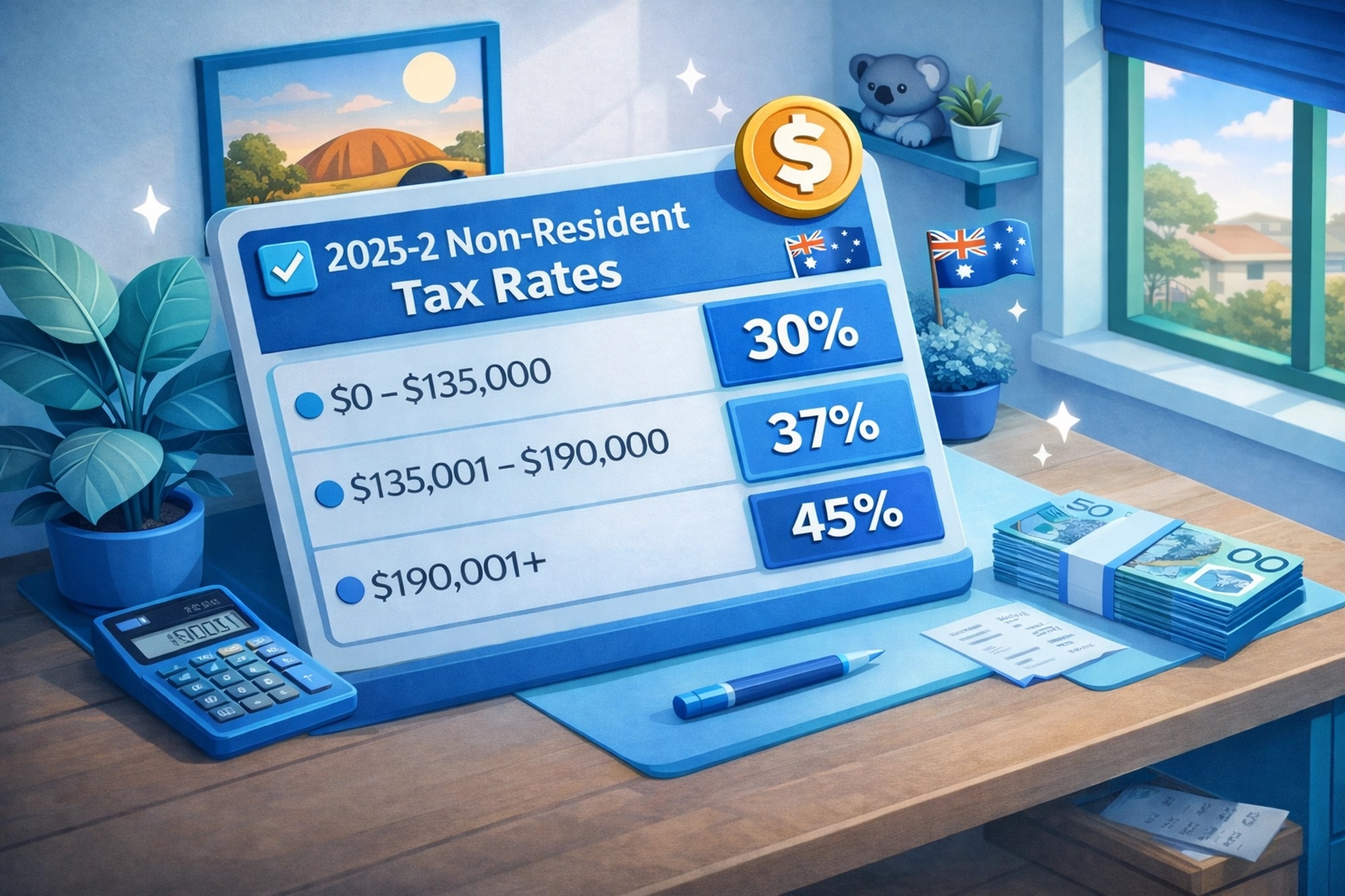
This is why correctly establishing your tax residency matters so much. A migrant earning $80,000 who is incorrectly treated as a non-resident pays $24,000 in income tax. The same migrant correctly treated as a resident pays $14,788. The difference is over $9,000.
SettleMate's Tip: SettleMate recommends every migrant run their salary through the ATO's income tax estimator at ato.gov.au before their first pay day to understand what tax should be withheld. If your payslips show significantly more or less tax than the estimator predicts, address it immediately with your payroll team — it is easier to correct withholding in advance than to deal with a large tax bill or a delayed refund at the end of the year.
💳 STEP 7: PAYG Withholding — How Tax Is Collected From Your Pay
📋 Pay As You Go
In Australia, income tax is collected throughout the year through the PAYG (Pay As You Go) Withholding system. Your employer withholds an amount from every pay based on your TFN Declaration, your annual salary, and your claimed threshold — and remits it to the ATO on your behalf.
This is why most Australians receive a tax refund at tax time — the withholding system is designed to withhold slightly more than needed to ensure everyone pays enough, and the ATO refunds the difference when you lodge your return and claim deductions.
What affects your PAYG withholding amount:
- Whether you have claimed the tax-free threshold (if yes, lower withholding)
- Your taxable income level
- Whether you have a HECS-HELP student debt (higher withholding)
- Whether you have declared a second job
Your income statement:
From mid-July each year (after your employer finalises their data with the ATO), your income statement — showing your total earnings and tax withheld for the year — is available in your myGov account linked to the ATO. This is what you use to prepare your tax return. You no longer receive a physical payment summary — it is all digital through myGov.
SettleMate's Tip: SettleMate recommends waiting until mid-to-late July before lodging your tax return — even though the ATO opens for lodgement on 1 July. Most employers don't finalise their data until 14 July, and many banks and investment platforms don't update ATO records until late July. Lodging too early means your return may be missing pre-filled information, which increases the risk of errors and amendments.
🏦 STEP 8: Superannuation — How Australia's Compulsory Retirement System Works for Migrants
💰 Super — What It Is and What You're Entitled To

Superannuation is Australia's compulsory retirement savings system. Unlike many countries where retirement savings are optional or employer-discretionary, in Australia your employer is legally required to contribute to your retirement savings on top of your salary.
✅ The Super Guarantee Rate — 12% from 1 July 2025
From 1 July 2025, the Superannuation Guarantee (SG) rate is 12% of your Ordinary Time Earnings (OTE). This means your employer must contribute an amount equal to 12% of your salary into a superannuation fund on your behalf. This is in addition to your salary — not deducted from it.
For example: If you earn $70,000 per year, your employer must contribute $8,400 into your super fund annually, on top of your $70,000 salary. Your total remuneration package is effectively $78,400.
The 12% rate is the final step in a legislated increase schedule. It applies from 1 July 2025 and is expected to remain at 12% unless Parliament legislates further changes.
✅ Who Is Entitled to Super?
All eligible employees are entitled to the Superannuation Guarantee, including:
- Full-time, part-time, and casual employees
- Temporary visa holders (including 482, 485, 500, 491 visa holders)
- Working holiday makers (417/462) — yes, WHMs get super
- Employees of any age (no minimum or maximum age restriction since 2022)
- There is no minimum earnings threshold — even part-time workers earning small amounts are entitled to super
Contractors may also be entitled: If your contract is principally for your labour rather than for a result, you may be treated as an employee for super purposes even if you hold an ABN.
✅ Choosing Your Superannuation Fund
When you start a new job in Australia, you have the right to choose which super fund your employer contributes to. Your employer will provide a Superannuation Standard Choice Form — complete it and nominate your preferred fund. If you don't make a choice, your employer will pay into their default fund or, under the "stapling" rules introduced in 2021, into a super fund from a previous job.
Comparing super funds: Funds differ in fees, investment options, performance track record, and insurance cover. Compare funds at moneysmart.gov.au before choosing. Popular funds include AustralianSuper, Hostplus, REST, and UniSuper (for university employees).
✅ What Happens to Your Super When You Leave Australia?
If you are a temporary resident (not an Australian citizen or permanent resident) and you leave Australia permanently, you can claim your accumulated super back through the Departing Australia Superannuation Payment (DASP) scheme.
Note: DASP payments are taxed. The withholding tax rate on DASP for most temporary residents is 35%, and for working holiday makers it is 65%. This is a significant reduction of your accumulated super balance — factor it into your financial planning.
To claim DASP: Apply through the ATO's online DASP system after your visa expires or is cancelled and you have left Australia. You will need your TFN, super fund details, and evidence of departure.
SettleMate's Tip: SettleMate strongly recommends checking that your super is being paid correctly from your very first payslip. Around $5 billion worth of superannuation goes unpaid every year in Australia — often because of employer errors, deliberate underpayment, or miscalculation. Check ATO Online Services through myGov to see your super fund and the contributions your employer is reporting. If no contributions appear within three months of starting work, contact your employer in writing and then the ATO if the issue isn't resolved.
🏥 STEP 9: The Medicare Levy — What You Pay and Who Is Exempt
💊 The 2% Healthcare contribution
Most Australian tax residents pay the Medicare levy of 2% of their taxable income each financial year. This is separate from income tax and funds the public Medicare healthcare system.
Medicare levy applies to:
- Australian citizens and permanent residents who are Medicare eligible
- Temporary residents who are eligible for Medicare (e.g. citizens of RHCA countries who have enrolled)
- Most people living and working in Australia as Australian tax residents
Medicare levy exemption — who can claim it:
- Foreign residents for tax purposes are not liable for the Medicare levy
- Temporary residents who are not eligible for Medicare may be entitled to an exemption for the days they were not eligible
- If you are on a visa that does not qualify for Medicare (such as most 482 or 417 visa holders), you can claim a Medicare Levy Exemption on your tax return for the relevant period
How to claim the exemption: In myTax when lodging your return, indicate the number of days during the year you were not entitled to Medicare. The ATO calculates your exemption automatically.
This is an important money-saver for migrants on visa types that don't qualify for Medicare — many migrants pay the full 2% levy throughout the year through PAYG withholding, then recover it on their tax return.
The Medicare Levy Surcharge is an additional 1%–1.5% tax for higher-income earners (singles earning over $101,000; families over $202,000) who do not hold appropriate private hospital cover.
📂 STEP 10: What You Can Deduct — Common Tax Deductions for Migrants
💡Reducing Your Taxable Income

Tax deductions reduce your taxable income — and therefore reduce the amount of tax you pay. A $1,000 deduction for someone in the 30% tax bracket saves them $300 in tax. The rule in Australia is that you can claim a deduction for expenses that are directly and genuinely related to earning your income, that you spent the money yourself, and that you have a record (receipt) to prove it.
Three rules every migrant must know:
- The expense must be directly connected to your income-earning work
- You must have already paid it yourself (not been reimbursed by your employer)
- You must have a receipt or record — you cannot claim expenses you cannot prove
✅ Common Deductions for Employed Migrants
Work-related expenses (with receipts):
- Professional membership fees and subscriptions required for your job
- Work-related study and training courses
- Tools and equipment required for work that you personally purchased
- Uniforms and protective clothing (if required and not reimbursed)
- Union membership fees
Work from home:
- If you work from home, you can claim a portion of home office expenses
- The ATO's fixed rate method is 70 cents per hour worked from home (as of 2024–25), covering electricity, internet, and stationery
- Alternatively, the actual cost method claims actual expenses based on floor area proportion
Vehicle and travel:
- If you use your personal car for work-related travel (not commuting between home and work), you can claim motor vehicle expenses
- The cents per kilometre method is 88 cents per kilometre for 2024–25 (up to 5,000 km without a logbook)
- Alternatively, maintain a logbook to claim actual expenses
What you cannot claim:
- Commuting costs (travel from home to work and back) — this is the most common mistake
- Meals and entertainment (unless for business and you are self-employed)
- Personal grooming, clothing, or gym memberships (unless specifically required by your employer)
- Childcare costs
- Personal superannuation contributions to a fund you cannot access
✅ If You Are Self-Employed or Have an ABN
If you operate as a sole trader or contractor, you can claim a broader range of expenses directly related to your business income. Keep records of all business expenses including phone bills, software subscriptions, home office costs, and any purchases made for business purposes.
SettleMate's Tip: SettleMate recommends keeping all work-related receipts throughout the year in a dedicated folder — either physical or digital (a Google Drive folder or the ATO's myDeductions app within the ATO app works well). Many migrants lose deductions they were legitimately entitled to simply because they didn't keep the receipt at the time. A $500 laptop purchased for work, with a receipt, saves a migrant in the 30% bracket $150 in tax. Without the receipt, it's $0.
📱 STEP 11: How to Lodge Your Australian Tax Return
💻 The Process from Start to Finish

For most migrants with straightforward employment income, lodging your Australian tax return is genuinely straightforward using the ATO's myTax system, accessed through your myGov account.
✅ Step-by-Step: Lodging Your Return via myTax
Step 1: Log into your myGov account at my.gov.au. Confirm your ATO is linked.
Step 2: Wait until mid-to-late July after the financial year ends. By this time, most employers, banks, and other institutions will have submitted data to the ATO and your return will be pre-filled with accurate information.
Step 3: In myGov, click on "Australian Taxation Office" and select "Lodge a tax return."
Step 4: Review all pre-filled information:
- Your income from all employers (from your income statement)
- Bank interest earned
- Government payments (if any)
- Health insurance details
- HECS-HELP debt (if applicable)
Step 5: Add any income not pre-filled — rental income, freelance income, foreign income if you are a resident (not temporary resident).
Step 6: Add your deductions — work-related expenses, vehicle costs, home office expenses. You need the amount and a description for each. The ATO checks deductions against industry benchmarks, so be accurate.
Step 7: Confirm your tax residency status for the year. If you arrived mid-year, declare the date you became a resident.
Step 8: Confirm your Medicare levy status. If you were not entitled to Medicare for part of the year, claim the exemption for those days.
Step 9: Review the calculated refund or amount payable. Check everything looks correct.
Step 10: Submit. The ATO typically processes online returns and issues assessments within 2 weeks. Refunds are deposited directly into the bank account on file in your myGov profile.
✅ Should You Use a Registered Tax Agent?
For your first year in Australia, or if you have complex circumstances (multiple income sources, investments, foreign income, rental properties), a registered tax agent is worth considering. Advantages include:
- They handle all the complexity and reduce the risk of errors
- They are liable for professional advice they give you
- They can identify deductions you might not know about
- They extend your lodgement deadline to 15 May the following year
- Their fees are often tax deductible themselves
Find a registered tax agent through the Tax Practitioners Board at tpb.gov.au. Always verify registration before engaging any tax advisor.
Never use an unregistered "tax agent" or an online service that is not the ATO. TFN and tax return scams targeting migrants are well documented.
⏰ STEP 12: The Tax Return Deadline — When to Lodge and What Happens If You're Late
📅 Key Dates Every Migrant Must Know
What happens if you lodge late?
The ATO applies Failure to Lodge (FTL) penalties for late returns:
- $330 per 28-day period (or part thereof) that the return is overdue
- Maximum penalty of $1,650 (5 penalty units)
- Interest charges also apply on any outstanding tax debt
The most important practical rule: it is always better to lodge late than not at all. If you miss the deadline, lodge as soon as possible — the longer you wait, the larger the penalty.
If you didn't earn income above the tax-free threshold:
You may not need to lodge a full return, but you should still submit a Non-Lodgement Advice (NLA) to the ATO to confirm you are not required to lodge. This prevents the ATO from following up with penalties for an outstanding return.
ATO tax calendar — key dates for FY2025–26:
- 30 June 2026 — Financial year ends (EOFY). Super contributions and deductible purchases must happen before this date.
- 14 July 2026 — Employers must finalise income statements with the ATO. Wait until after this date to lodge.
- 1 July 2026 — myTax opens for FY2025–26 lodgement.
- 31 October 2026 — Self-lodgement deadline.
- 15 May 2027 — Tax agent deadline (if registered before 31 October 2026).
💡 Money-Saving Tips for Tax Time
- Apply for your TFN on Day 1 of arriving in Australia. The 47% withholding rate in the absence of a TFN costs migrants far more than any other single administrative delay.
- Claim the tax-free threshold from your primary employer — the job where you earn most of your income. Do not claim it from multiple employers.
- Keep all work-related receipts throughout the year — in a Google Drive folder, the ATO myDeductions app, or an old-fashioned envelope. You cannot claim what you cannot prove.
- Wait until late July to lodge your return — this ensures income statements from employers and banks are pre-filled, reducing errors and amendments.
- Temporary residents: don't declare your foreign bank interest. If you hold a temporary visa and are a temporary resident for tax purposes, most income from foreign sources does not need to be declared. Confirm this with a tax agent for your specific situation.
- Check that your employer is paying your super. Log into ATO Online Services through myGov and verify super contributions are appearing for the correct fund.
- If you use a tax agent, engage them before 31 October — this gives you until 15 May the following year, reducing deadline pressure.
- Claim the Medicare levy exemption if you were not entitled to Medicare for part or all of the year, this 2% recovery adds up significantly on higher incomes.
📌 Official & Trusted Resources
This guide is informed by:
- Australian Taxation Office (ATO) — ato.gov.au (all tax rates, TFN, residency tests, myTax)
- ATO — Tax rates for Australian residents — ato.gov.au/tax-rates-and-codes/tax-rates-australian-residents
- ATO — Tax rates for working holiday makers — ato.gov.au/tax-rates-and-codes/tax-rates-working-holiday-makers
- ATO — Foreign and temporary residents — ato.gov.au/individuals-and-families/coming-to-australia-or-going-overseas/your-tax-residency/foreign-and-temporary-residents
- ATO — Super guarantee rates — ato.gov.au/tax-rates-and-codes/key-superannuation-rates-and-thresholds/super-guarantee
- ATO — TFN application for permanent migrants and temporary visitors — ato.gov.au/individuals-and-families/tax-file-number/apply-for-a-tfn
- MoneySmart (ASIC) — moneysmart.gov.au (superannuation comparison)
- Tax Practitioners Board — tpb.gov.au (verify registered tax agents)
Disclaimer
This guide is provided for general informational purposes only. While SettleMate strives to keep all information accurate and up to date, tax laws, rates, and ATO rules change annually and may vary based on individual circumstances, visa type, and income structure. This content does not constitute tax, legal, migration, or financial advice. SettleMate is not a registered tax agent, registered migration agent, or financial adviser. Always verify tax information through the official ATO website at ato.gov.au and seek advice from a registered tax agent for your specific situation. Registered tax agents can be verified through the Tax Practitioners Board at tpb.gov.au.
Sharing & Usage
This guide is original content created by SettleMate. You are welcome to share, link to, or quote this guide for personal, educational, or non-commercial purposes, provided SettleMate is clearly credited as the source.
© SettleMate. All rights reserved. settlemate.au
Made with ❤️ for immigrants in Australia
Let's chat like humans, not forms
Answer a few quick questions and we'll route your note to a certified expert, no matter where you are in the world.
SettleMate Response Promise
Every conversation is reviewed by a specialist within 24 hours (often much sooner), and you'll always get a personalised next step.
- Thoughtfully reviewed by a real specialist.
- Personalized replies tailored to your unique situation.
- Actionable next steps, delivered clearly after each consultation.
Need something faster?
Reach us directly
Prefer a quick reply? Use any of the touchpoints below and our concierge team will jump in.