The Rising Cost of Living in Australia: What Migrants Need to Know in 2026
As of May 2026
Australia is genuinely one of the best countries in the world to build a life. Strong wages, world-class healthcare through Medicare, incredible weather, and a culture that is genuinely welcoming to migrants. But here is what the brochures do not always say upfront: it is also expensive — and in 2026, it is getting more expensive by the month.
The Australian Bureau of Statistics confirmed that the Consumer Price Index (CPI) rose 4.6% in the 12 months to March 2026 — the highest reading since September 2023, and well above the Reserve Bank of Australia's 2–3% target. Housing costs jumped 6.5%. Transport surged 8.9%, partly driven by fuel prices rising amid the Middle East conflict. Electricity bills — once softened by government rebates — have climbed sharply now that those rebates have expired.
If you are planning to move to Australia, just arrived, or trying to figure out why your money is not stretching as far as you expected, this guide is for you. SettleMate will walk you through what everything actually costs in 2026 — rent, groceries, electricity, transport, healthcare — city by city, with honest numbers and practical tips to manage it all.
First, the Big Picture: What Is Actually Going Up?
Let's start with the data, because understanding what is rising and by how much helps you budget and plan rather than just feel anxious about it.
According to the ABS Consumer Price Index for March 2026, here is how different spending categories moved in the past 12 months:
- Housing: up 6.5% — driven by rent increases, higher electricity costs, and rising new dwelling construction costs
- Transport: up 8.9% — the biggest mover, driven by a surge in fuel prices
- Clothing and footwear: up 7.1%
- Education: up 4.8%
- Alcohol and tobacco: up 4.4%
- Food and non-alcoholic beverages: up 3.1%
- Health: up 3.0%
- Insurance and financial services: up 2.8%
- Recreation and culture: up 2.8%
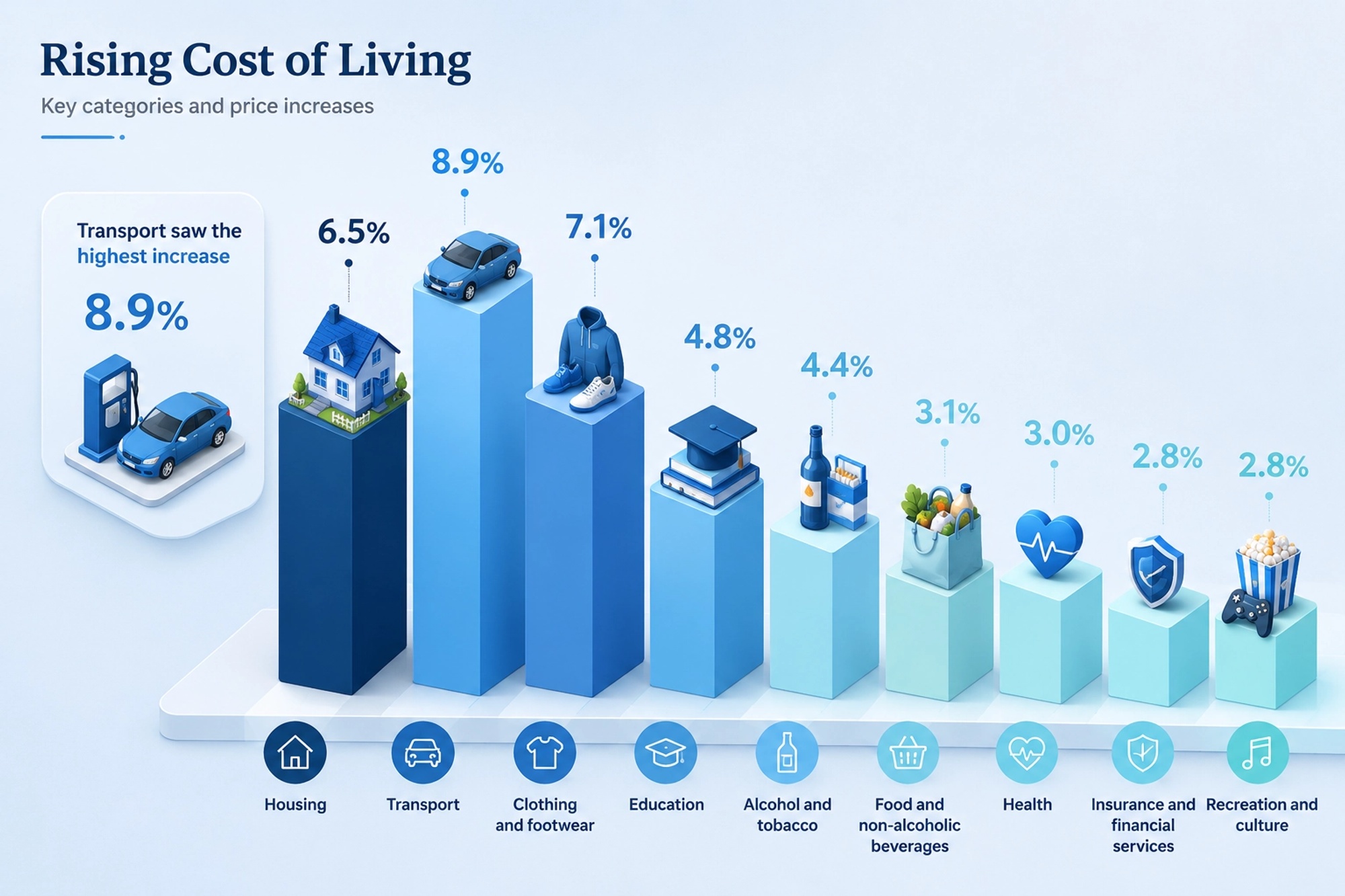
The two categories that hit migrants hardest on arrival — housing and food — are both running well above the long-term average. And electricity, buried inside the housing figure, deserves special attention: electricity costs rose 25.4% in the 12 months to March 2026, almost entirely because the Commonwealth and State government energy rebates that kept bills artificially low have now ended.
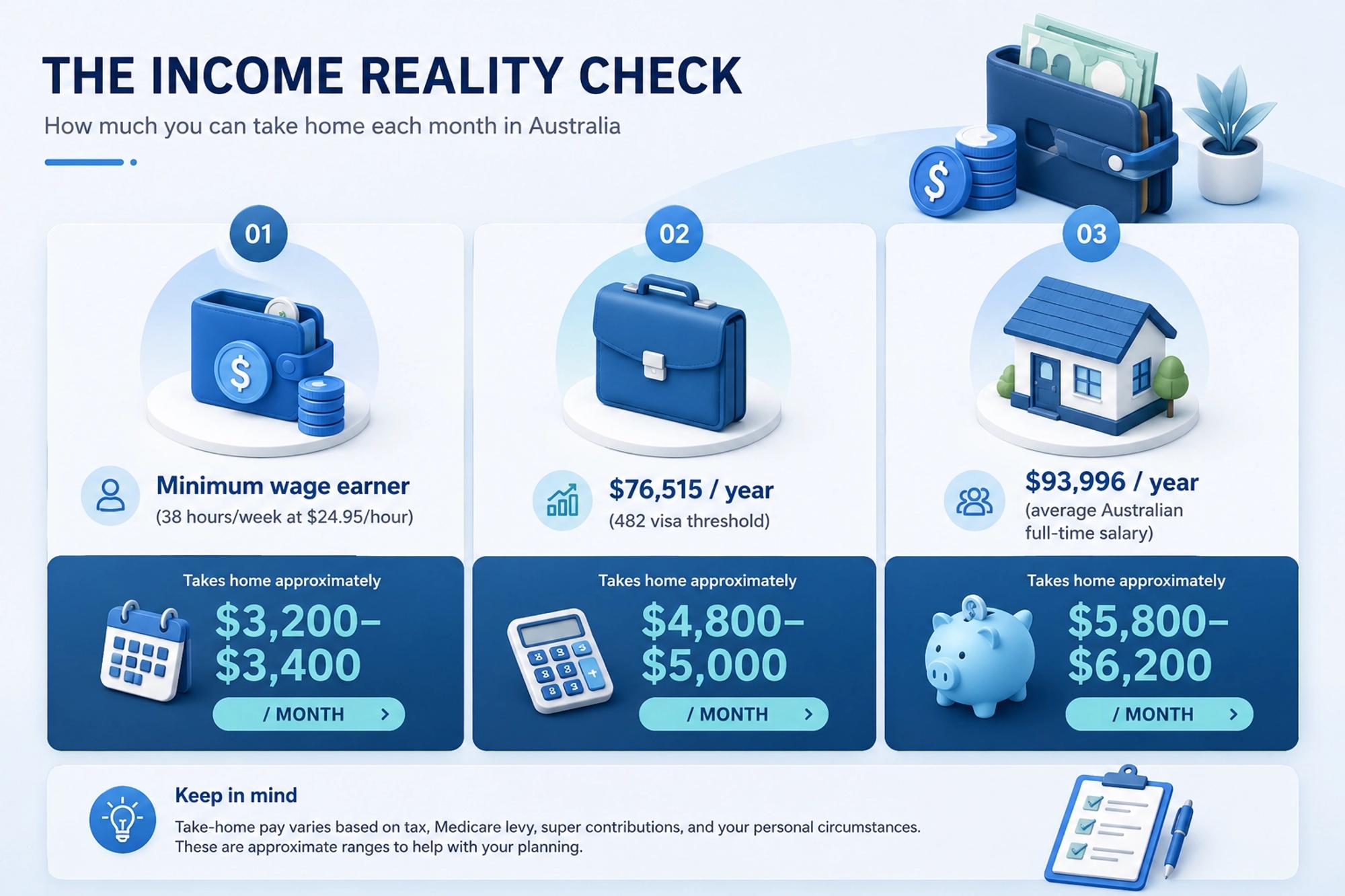
Here is the good news, though: Australia's wages are also rising. The Wage Price Index grew 3.4% over the same period, and the national minimum wage sits at $24.95 per hour — one of the highest in the world. For migrants on skilled worker visas, the minimum salary threshold for the 482 (Skills in Demand) visa is $76,515 per year — rising to $79,499 from 1 July 2026. Australia is expensive, but it also pays well. The key is planning for what you are walking into.
SettleMate's Tip: SettleMate recommends that every migrant build a city-specific monthly budget before they arrive — not a generic one. The difference in cost of living between Sydney and Adelaide for a single person can be $800 to $1,000 per month for a comparable lifestyle. That gap is significant enough to affect which city makes financial sense for your situation. Use the numbers in this guide as your starting point.
🏠 Housing: The Biggest Expense by Far
Rent is the single largest cost for almost every migrant in Australia, and it is the number that has caused the most financial stress for new arrivals in recent years.
According to Domain's rental data and ABS figures, here is what you can expect to pay in weekly rent across Australia's major cities as of late 2025 and into 2026:
For a 2-bedroom apartment (median weekly rent):
- Sydney: $700 – $850
- Melbourne: $500 – $580
- Brisbane: $520 – $600
- Perth: $550 – $630
- Adelaide: $440 – $500
For a unit (any size), median weekly rent:
- Sydney: $750
- Brisbane: $590
- Perth: $570
- Melbourne: $550
- Adelaide: ~$480
The national median rent across houses and units combined sits at approximately $685 per week, up 3.2% from 2025.
Before you move in, budget for these upfront costs: In Australia, when you sign a lease you pay a bond (security deposit) equal to four weeks of rent, plus typically two weeks of rent in advance. That means in Sydney, before you sleep in your new place, you may need $6,000 to $8,000 in cash just to secure it. In Adelaide or regional areas, this is more manageable — but it still catches many new arrivals off guard.
The most practical cost-saving strategy on rent: Choose outer suburbs or satellite cities. Suburbs like Blacktown (Sydney), Melton (Melbourne), or Ipswich (Brisbane) can reduce weekly rent by 20–30% while keeping commute times under 45 minutes. Regional cities like Geelong, the Central Coast, Ballarat, and Toowoomba offer rents 30–50% lower than their nearest capital while still providing access to good employment and services.
Regional median rents for houses sit around $480–$550 per week — compared to $625–$775 in the capitals. And if you are on a subclass 491 regional visa, living regionally is already a condition of your visa — which means you are also benefiting from a lower cost of living while building your PR pathway.
SettleMate's Tip: SettleMate consistently tells new arrivals: the 30% rule matters. Australian financial guidance suggests spending no more than 30% of your gross household income on rent. Spending more than that puts you in "rental stress" — meaning housing is consuming so much of your income that other essentials become difficult to manage. If you're a single person earning $60,000 a year (take-home roughly $4,400/month), your rent should ideally not exceed $1,320 per month. In Sydney's inner suburbs, that is very difficult to achieve. It is one of many reasons why choosing your city wisely is one of the most important financial decisions you make before arriving.
🛒 Groceries: Stable but Still Costly
The good news here is that food inflation has moderated compared to 2022 and 2023. The bad news is that it is still up 3.1% year-on-year, and Australian grocery prices were already high by global standards.
Here is what a realistic monthly grocery budget looks like in 2026:
- Single person: $300 – $600 per month (roughly $70 – $150 per week)
- Couple: $800 – $1,000 per month
- Family of four: $1,200 – $1,600 per month
Grocery costs are relatively consistent across Australian cities — unlike rent, where city choice makes an enormous difference. What does make a difference is where you shop.
Australia's three main supermarket chains are Coles, Woolworths, and Aldi. Shopping at Aldi rather than Coles or Woolworths reduces your grocery bill by roughly 10–15%. Buying non-perishables in bulk and checking weekly specials helps further.
The single biggest lever on your food budget, though, is cooking at home versus eating out. A casual meal for two at a restaurant in Australia easily costs $60–$90 including drinks. A coffee costs around $5–$6. If you eat out regularly, your food costs can double or triple compared to cooking at home. This is not a moral judgement — it is just a number to know.
SettleMate's Tip: SettleMate recommends familiarising yourself with the Coles and Woolworths app before you arrive — both have weekly specials, digital catalogues, and loyalty programs that can meaningfully reduce your grocery spend. If you have dietary preferences tied to your home culture, check the availability and pricing at Indian, Asian, or Middle Eastern grocery stores in your area. These specialty stores often offer staples like lentils, spices, rice, and vegetables at significantly lower prices than mainstream supermarkets.
⚡ Electricity and Utilities: The Bill That Shocked Most Migrants in 2026
This is the cost category that has surprised more migrants in 2026 than any other. Electricity costs rose 25.4% in the 12 months to March 2026 — a direct consequence of government energy rebates ending. If you arrived in 2023 or 2024, your electricity bills were artificially low. In 2026, they are not.
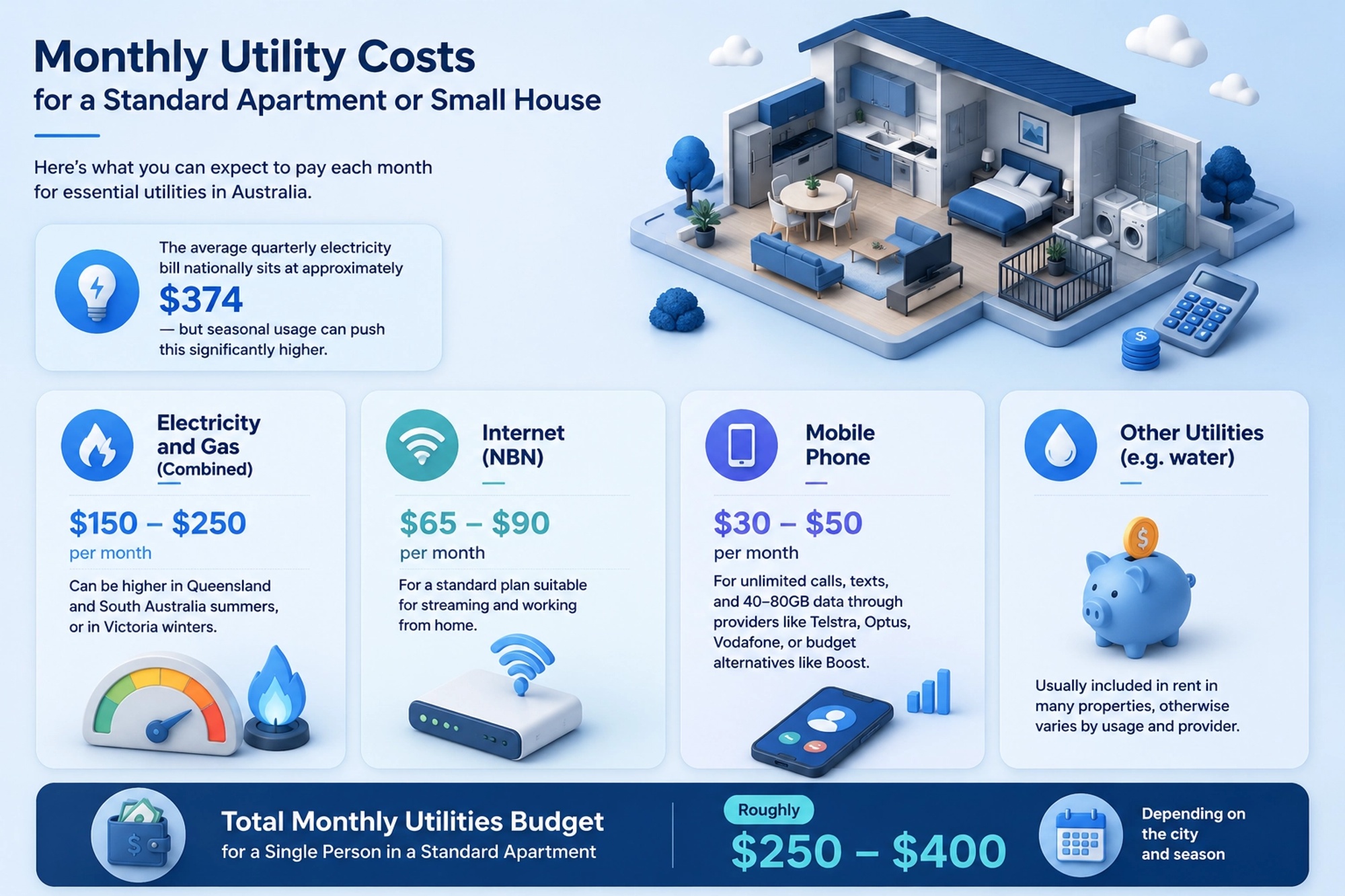
Here is what to expect for a standard apartment or small house in terms of monthly utility costs:
- Electricity and gas (combined): $150 – $250 per month (can be higher in Queensland and South Australia summers, or in Victoria winters)
- The average quarterly electricity bill nationally sits at approximately $374 — but seasonal usage can push this significantly higher
- Internet (NBN): $65 – $90 per month for a standard plan suitable for streaming and working from home
- Mobile phone: $30 – $50 per month for unlimited calls, texts, and 40–80GB data through providers like Telstra, Optus, Vodafone, or budget alternatives like Boost
Total monthly utilities budget for a single person in a standard apartment: roughly $250 – $400, depending on the city and season.
Practical ways to reduce electricity costs:
- Use reverse-cycle air conditioning efficiently — cool or heat only the room you are using
- Check if your energy provider offers off-peak pricing and shift high-usage appliances to off-peak hours
- Compare energy providers using the Australian Government's Energy Made Easy tool at energymadeeasy.gov.au — switching can save $200–$500 per year
SettleMate's Tip: SettleMate recommends that new arrivals do not sign any fixed energy contract in their first month. Use a month-to-month plan initially, compare providers through energymadeeasy.gov.au after a couple of billing cycles when you know your actual usage patterns, and then lock in the best deal. Signing a contract before you understand your usage in a new city is one of the most common financial mistakes migrants make in their first year.
Explore SettleMate's Settlement Hub →
🚇 Transport: It Depends Enormously on Your City
How much you spend on getting around depends heavily on which city you live in and whether you need a car.
Sydney and Melbourne have the most comprehensive public transport networks — trains, buses, trams (Melbourne), and ferries (Sydney) reach most suburbs. A monthly public transport budget for regular commuters is roughly $150–$220. In Sydney, the Opal card is the standard contactless payment system. Melbourne uses Myki.
Brisbane stands out significantly: Queensland introduced a 50-cent flat fare on all public transport in 2024, and it is still running in 2026. This makes Brisbane and South-East Queensland by far the cheapest capital city region for commuting — a meaningful financial advantage if you are choosing between cities.
Perth, Adelaide, and most outer suburbs are more car-dependent. If you live in an area without strong public transport access — which describes a large part of Australia outside the inner suburbs of Sydney and Melbourne — a car becomes a practical necessity.
Car ownership costs in Australia:
- Fuel: fluctuates, but budget $200–$300/month for regular use
- Registration and insurance: varies by state, but roughly $150–$200/month when annualised
- Maintenance: budget $100–$150/month
- Total car ownership cost: approximately $400–$600/month, more for financed vehicles
If you can live near public transport in Sydney or Melbourne, the financial saving versus owning a car is substantial over a year.
🏥 Healthcare: What Migrants Actually Pay
This depends entirely on your visa type.
Medicare-eligible visa holders (generally permanent residents and many temporary visas including 482 and 485) can access bulk-billed GP consultations at no cost — though bulk billing availability has declined in metropolitan areas in recent years. Where bulk billing is not available, expect a gap fee of $30–$80 per GP visit.
International students on a subclass 500 visa are not eligible for Medicare and must hold Overseas Student Health Cover (OSHC) for the duration of their visa. OSHC is a mandatory visa condition. The cost varies by provider and coverage level, but budget approximately $500–$700 per year for single coverage. OSHC covers GP visits and hospital, but gap fees still apply in many cases.
Working Holiday makers on 417 or 462 visas from certain countries have reciprocal healthcare agreements with Australia (the UK, Ireland, Sweden, Norway, Finland, Italy, Belgium, Malta, and the Netherlands). Check whether your country is covered. If not, you are not eligible for Medicare and should arrange appropriate health insurance.
💰 Putting It All Together: Realistic Monthly Budgets
Here is what a realistic monthly budget looks like for a single person in 2026, depending on city and living arrangement:
Shared accommodation (renting a room):
- Sydney: $2,200 – $2,800/month
- Melbourne: $1,900 – $2,400/month
- Brisbane: $1,700 – $2,100/month
- Adelaide: $1,500 – $1,900/month
Private rental (own 1-bedroom apartment):
- Sydney: $3,500 – $4,500/month
- Melbourne: $3,000 – $3,800/month
- Brisbane: $2,800 – $3,400/month
- Adelaide: $2,400 – $3,000/month
These figures include rent, groceries, utilities, transport, and a moderate social budget. They do not include health insurance (if required), visa fees, professional clothing, children's costs, or savings.
The honest conclusion: on minimum wage in Sydney or Melbourne, private renting alone is financially very difficult. Shared accommodation is the practical strategy for most new arrivals until income grows.
SettleMate's Tip: SettleMate recommends every migrant arrive with a minimum of three months of living expenses saved before their first Australian payday. That means at least $6,000–$10,000 accessible in cash or a bank account you can access from day one. The first month in particular — paying the rental bond, buying essentials for a new home, setting up phone and internet, and covering food before your first pay — is almost always more expensive than expected. Being financially prepared for that landing removes an enormous amount of stress from an already big transition.
SettleMate's Take
Australia is genuinely worth it for most migrants and the data backs that up. Wages are strong, workers' rights are protected, and the quality of life is real. But 2026 is a harder financial year than 2022 or 2023. Inflation is running hot, rent has not meaningfully softened in most capitals, and electricity bills have jumped sharply. The migrants who navigate this well are not the ones who earn the most but the ones who planned before they arrived. Know your city. Know your true monthly budget. Build your savings cushion. And use the resources available to you, including SettleMate's settlement hub, to make sure no financial surprise catches you off guard.
Frequently Asked Questions
Q: How much money do I need to live in Australia in 2026? A single person in shared accommodation needs approximately $2,200–$2,800 per month in Sydney, and $1,500–$1,900 in Adelaide. In private rental, budget $3,500–$4,500 in Sydney or $2,400–$3,000 in Adelaide. These figures cover rent, groceries, transport, utilities, and a modest social budget.
Q: How much does an international student need per month in Australia? The Australian Government requires international student visa (subclass 500) applicants to demonstrate they have at least $29,710 per year (approximately $2,476 per month) for living expenses. In practice, most students budget $2,500–$3,000 per month to cover rent, food, transport, and study costs comfortably.
Q: Is the cost of living in Australia increasing in 2026? Yes. Australia's CPI rose 4.6% in the 12 months to March 2026, according to the ABS — the highest reading since September 2023. Housing costs rose 6.5%, transport 8.9%, and electricity 25.4%. The overall trend reflects the end of government energy rebates and ongoing pressure on housing supply.
Q: Which city in Australia is cheapest for migrants? Adelaide is consistently the most affordable major capital city in Australia, with lower rents and lower overall living costs than Sydney, Melbourne, or Brisbane. For a single person, living in Adelaide versus Sydney can mean $800–$1,000 less in monthly expenses for a comparable lifestyle. Regional cities like Geelong, Toowoomba, Ballarat, and the Central Coast offer even lower costs.
Q: How much is rent in Australia in 2026? Median weekly rent for a 2-bedroom apartment ranges from $700–$850 in Sydney to $440–$500 in Adelaide. The national median rent across all property types is approximately $685 per week. Rents in outer suburbs and regional areas are typically 20–50% lower than capital city inner suburbs.
Q: Do migrants get Medicare in Australia? It depends on your visa type. Permanent residents and many temporary visa holders (including 482 and 485) are generally Medicare-eligible. International students on subclass 500 are not eligible for Medicare and must hold Overseas Student Health Cover (OSHC). Working holiday makers should check whether their home country has a reciprocal healthcare agreement with Australia.
Q: How much does electricity cost in Australia in 2026? The average quarterly electricity bill nationally is approximately $374. Monthly electricity and gas combined typically costs $150–$250 for a standard apartment. Bills are higher in summer (air conditioning) and winter (heating), and electricity costs rose 25.4% in the 12 months to March 2026 following the end of government energy rebates.
Q: Can migrants save money while living in Australia? Yes — but it depends heavily on city choice, living arrangement, and lifestyle. A skilled worker earning $82,000 in Brisbane with shared accommodation can realistically save $1,800–$2,200 per month. The same person in Sydney on the same salary may save as little as $1,000–$1,200. Choosing a lower-cost city, opting for shared housing, cooking at home regularly, and using public transport where available are the most impactful strategies.
📌 Official & Trusted Resources This article is informed by:
- Australian Bureau of Statistics — Consumer Price Index, March 2026: abs.gov.au
- Australian Bureau of Statistics — Selected Living Cost Indexes, March 2026: abs.gov.au
- Domain Rental Report, September 2025: domain.com.au
- Australian Government — energymadeeasy.gov.au
- Fair Work Ombudsman — National Minimum Wage: fairwork.gov.au
Disclaimer
This article is for general informational purposes only. All figures are based on publicly available data current as of May 2026 and are subject to change. SettleMate is not a financial adviser. For personalised financial guidance, consult a qualified financial professional.
Sharing & Usage
This blog is an original content created by SettleMate. You are welcome to share, link to, or quote this blog for personal, educational, or non-commercial purposes, provided SettleMate is clearly credited as the source.
© SettleMate. All rights reserved. settlemate.au
Made with ❤️ for immigrants in Australia