Australia's Minimum Wage Is Rising to $26.44 an Hour From 1 July 2026
Decision handed down by the Fair Work Commission on 2 June 2026. Effective 1 July 2026.
If you work in Australia — on any visa, in any industry — your minimum pay entitlements are about to change. And if you work in hospitality, retail, healthcare, cleaning, aged care, or construction, this decision directly affects how much you must legally be paid from 1 July 2026.
On the morning of 2 June 2026, Fair Work Commission President Justice Adam Hatcher announced the outcome of the 2026 Annual Wage Review. The decision:
- Increases the National Minimum Wage from $24.95 to $26.44 per hour — a rise of nearly 6%
- Increases all modern award wage rates by 4.75% from 1 July 2026
- Gives Australia's lowest-paid workers an additional structural adjustment boost on top of the 4.75%, taking the lowest ongoing award rate to $26.44/hour
- Directly affects approximately 2.8 million Australian workers — 21.1% of the entire workforce
This is the largest wage increase since 2023's 5.75% rise, and it comes at a time when fuel prices, inflation, and cost-of-living pressures are squeezing migrant workers particularly hard.
Here is the complete plain-English breakdown — what changed, what it means for your specific situation, and exactly what to do on 1 July.
The Official Decision: What the Fair Work Commission Actually Said
The Fair Work Commission is Australia's independent workplace relations tribunal. Every year it conducts an Annual Wage Review — assessing economic conditions, inflation, cost of living, and the needs of workers and employers — and issues a binding determination that sets the minimum wage floor across the entire economy.
This year's decision was announced by FWC President Justice Adam Hatcher on 2 June 2026, live-streamed from the Commission's headquarters. It was described as "particularly challenging" given:
- Inflation rising from 3.7% in February to 4.2% by April 2026, with the Reserve Bank projecting it could reach 4.8% by June and the Federal Budget forecasting up to 5%
- Fuel supply disruptions caused by Middle East conflict pushing petrol and diesel prices sharply higher
- Three Reserve Bank interest rate rises complicating the economic outlook
- Ongoing cost-of-living pressures on low-income and migrant workers
Against that backdrop, Justice Hatcher acknowledged that the Commission could not fully restore the real value of wages lost to inflation since 2021, but committed to at minimum ensuring workers are not worse off in real terms than they were at 1 July 2025.
The unions (ACTU) had pushed for a 6% increase. Employer groups argued for 2.5–2.6%. The Commission landed at 4.75% for modern award workers — above inflation at 4.2% — making it a genuine real wage increase by the government's own measure. Treasurer Jim Chalmers confirmed this on the day of the decision.
The New Rates: What You Will Actually Be Paid From 1 July 2026
The National Minimum Wage
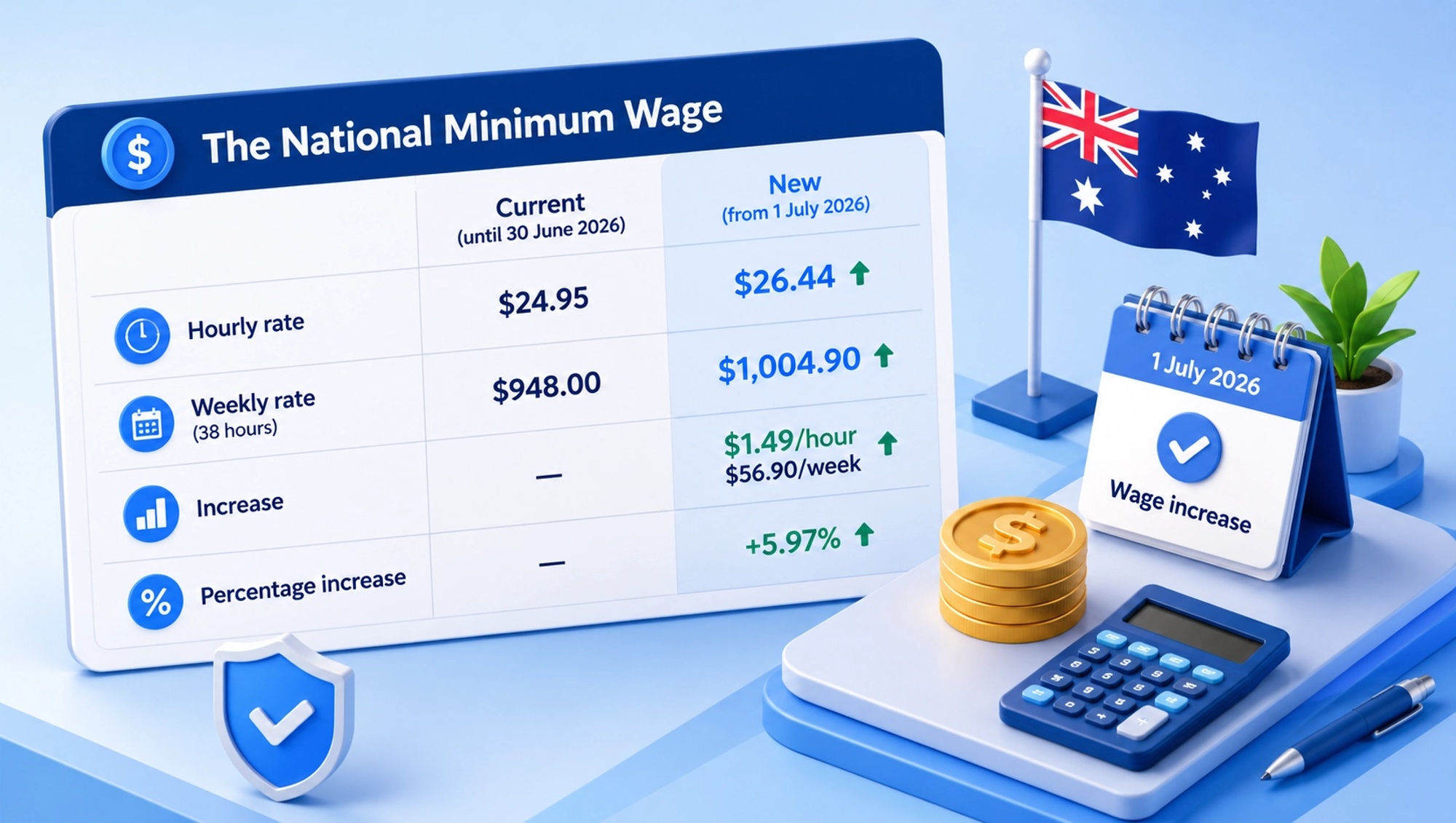
The National Minimum Wage applies to workers who are not covered by a modern award or enterprise agreement — in practice, a relatively small proportion of the workforce (approximately 0.7%). However, it sets the absolute floor that no employer can pay below.
Modern Award Wages — 4.75% increase
This is the rate that affects the vast majority of working migrants in Australia. Modern awards set minimum pay rates for specific industries and occupations. If your work is covered by a modern award — and most jobs in hospitality, retail, healthcare, construction, cleaning, and aged care are — your award minimum wages rise by 4.75% from 1 July 2026.
The lowest rate in any modern award is now $26.44/hour — this is the new floor for all ongoing employment covered by awards. No award classification for ongoing work can pay below this.
There is also a separate entry-level rate for new workers in their first 6 months in certain classifications: the floor for this is $25.74/hour ($978.10/week).
Casual Workers
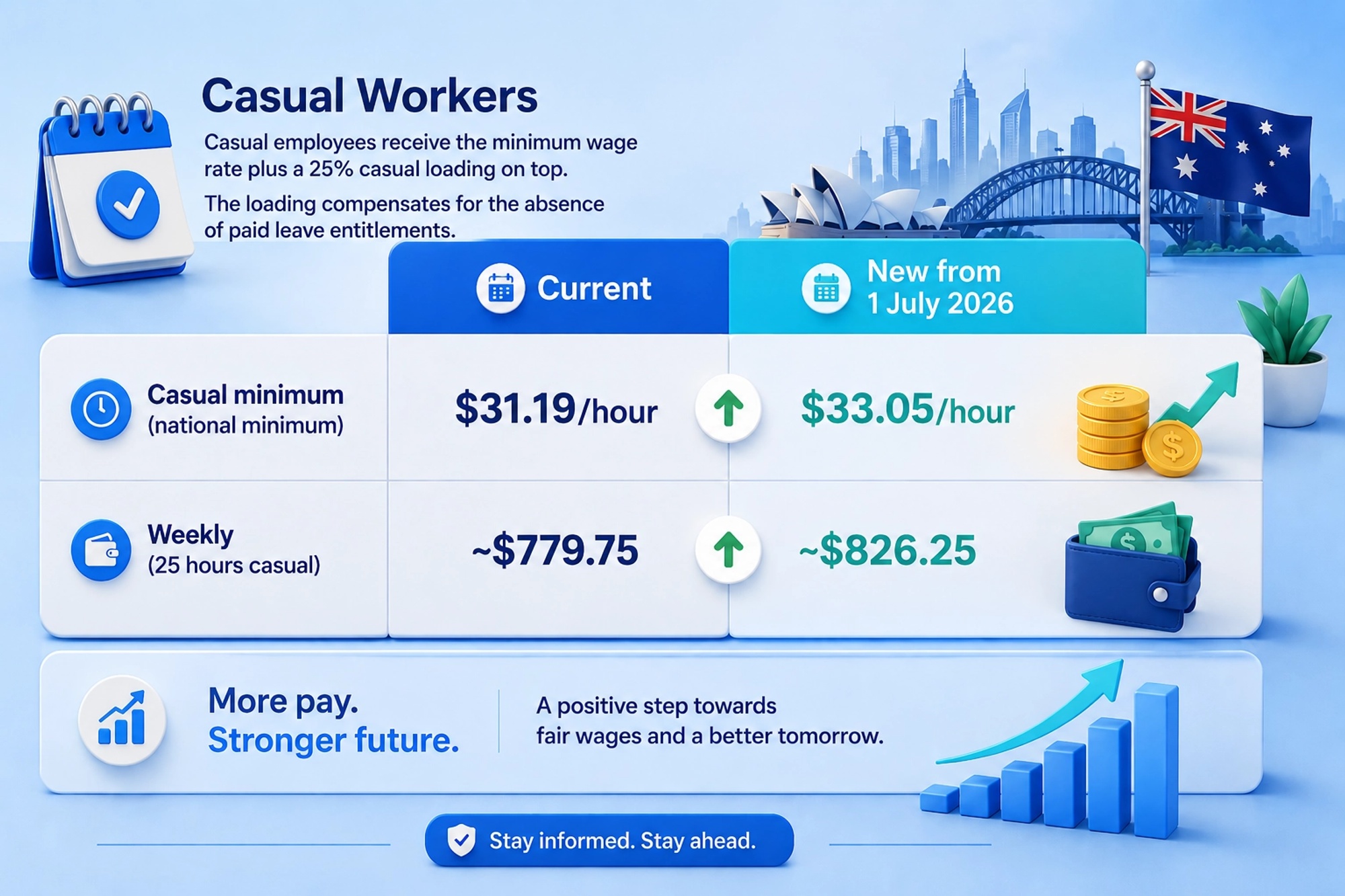
Casual employees receive the minimum wage rate plus a 25% casual loading on top. The loading compensates for the absence of paid leave entitlements.
The Structural Adjustment for Lowest-Paid Workers
This is the most significant element of the 2026 decision for workers at the very bottom of the wage scale — and it deserves a clear explanation.
The Commission decided that simply applying 4.75% to the C13 rate (the absolute lowest ongoing award classification) was not enough to protect these workers. It introduced a targeted structural adjustment, giving C13 and C14 workers an additional ~1.2% on top of the 4.75% — a total increase of approximately 6% — taking the C13 rate to $26.44/hour.
Approximately 100,000 of Australia's lowest-paid workers benefit from this structural adjustment. These are the workers in the absolute entry-level classifications across hospitality, cleaning, and general services.
The Commission also announced the phased elimination of the C13 classification itself — meaning over time, the lowest rate of ongoing award pay will be phased up entirely. This structural reform was foreshadowed in last year's review and is now being implemented in stages.
SettleMate's Tip: SettleMate wants every migrant worker to understand this clearly: the 4.75% increase applies to your award minimum wage — the legal minimum your employer must pay you for your role. If your employer was already paying you above the award rate, the 4.75% is not automatically applied to your full pay. However, your pay cannot fall below the new award minimum for your classification. Check your enterprise agreement or employment contract to understand what applies to you.
When Does the New Rate Apply? The "First Full Pay Period" Rule
This is a detail that catches many workers off guard. The new rates do not apply from the exact moment of 1 July 2026 in every case.
The decision states that new rates take effect from the first full pay period on or after 1 July 2026.
What this means in practice:
- If you are paid weekly and your pay week runs Monday to Sunday, the first full pay period after 1 July is the week starting Monday 6 July 2026. You will see the new rate in the pay for that week, paid the following Monday.
- If you are paid fortnightly with a pay period starting on 30 June, that period started before 1 July so the old rate applies. The new rate applies from the fortnightly period starting 7 July 2026.
- If you are paid monthly, check your payroll start date — the new rate applies from the first complete monthly pay period that starts on or after 1 July 2026.
Most workers covered by modern awards will see the new rate apply in the pay run of approximately 7–14 July 2026, depending on their pay cycle.
SettleMate's Tip: SettleMate recommends checking your first payslip after 1 July 2026 carefully against your award rate. The easiest way to find your award and its new minimum rates is through the Fair Work Ombudsman's Pay and Conditions Tool (PACT) at fairwork.gov.au/pay. Enter your job type, industry, and employment status and it will show you the exact rate that applies to you under the relevant award. Bookmark this tool.
Why This Matters Especially for Migrant Workers
Migrant workers are disproportionately concentrated in the industries most directly affected by award wage increases. The Fair Work Commission specifically identified healthcare and social assistance, retail trade, accommodation and food services, and administration and support services (which includes labour hire) as the industries with the largest proportions of award-reliant workers.
These are also the industries where migrant workers — particularly those on student visas, working holiday visas, 485 graduate visas, and 482 skilled worker visas — are most commonly employed.
Here is a practical guide to the industries most affected:
🍽️ Hospitality (accommodation and food services) One of the most award-reliant industries in Australia. Restaurant cooks, café workers, hotel housekeeping, bar staff — all covered by the Hospitality Industry (General) Award. New minimum rates apply from the first full pay period after 1 July.
🛒 Retail General retail, supermarkets, specialty stores — covered by the General Retail Industry Award. This is the most common employment sector for international students. The 4.75% increase flows through to all retail classifications.
🏥 Healthcare and aged care Nurses, aged care workers, community service workers — already in severe workforce shortage, with some of the most complex award structures in Australia. The Nurses Award, Aged Care Award, and Social, Community, Home Care and Disability Services Award all rise by 4.75%.
🧹 Cleaning and facilities Cleaning, security, caretaking — covered by the Cleaning Services Award and related awards. These workers tend to be among the most vulnerable to underpayment. The structural adjustment boost for C13/C14 classifications directly benefits many of these workers.
🏗️ Construction and trades Building trades, labourers, trade assistants — covered by construction industry awards. The 4.75% applies across the board.
Your Rights as a Migrant Worker — What the Law Says
This is the part SettleMate wants every migrant worker in Australia to know by heart.
Your visa type does not affect your minimum wage entitlement.
It does not matter whether you are on a student visa, a working holiday visa, an 482 employer-sponsored visa, a 485 graduate visa, or any other visa with work rights. Australian law requires that you receive the same minimum pay as any Australian worker in the same role. No exceptions. No exemptions. No employer can legally pay you below the award rate because of your immigration status.
This is confirmed by the Fair Work Act 2009 and enforced by the Fair Work Ombudsman (FWO). Employers who underpay migrant workers face significant civil penalties — recent court decisions have awarded underpaid migrants tens of thousands of dollars in back pay and compensation.
From 1 July 2026, two major changes affect your pay at the same time:
Your minimum award wage increases by 4.75% (as covered in this blog)
Payday Super begins — your employer must pay your superannuation at the same time as your wages, every pay cycle. You will be able to verify both your wage and your super contribution on the same payday.
This combination means from 1 July, you have more tools than ever to check whether your employer is meeting their obligations.
SettleMate's Tip: SettleMate recommends every migrant worker take three actions in the first week of July 2026. First, check your payslip against the new award rates using the FWO's PACT tool. Second, check your super fund account to confirm a super contribution arrived within 7 business days of your payday — this is the new Payday Super rule. Third, if either is wrong, report it. Reporting underpayment to the Fair Work Ombudsman will not affect your visa status. Your right to fair pay is protected regardless of visa type.
What If You Are Being Paid Below the New Minimum?
If you check your payslip after 1 July and you believe you are being paid below the new award minimum, here is exactly what to do.
Step 1: Find your correct award rate
Use the Pay and Conditions Tool at fairwork.gov.au/pay. Enter your industry, job type, and employment status. The tool will show you the exact award and the minimum hourly rate for your classification.
Step 2: Check your payslip against the new rate
Compare your hourly rate on your payslip against the award minimum. If your rate is below the new minimum for your classification after the first full pay period starting on or after 1 July 2026, you are being underpaid.
Step 3: Talk to your employer
Start by raising it directly. In some cases, payroll systems have simply not been updated for the new rates — particularly in smaller businesses. Put your concern in writing (a text message or email is sufficient) and keep a copy.
Step 4: If the issue is not resolved, contact the Fair Work Ombudsman
The Fair Work Ombudsman investigates underpayment complaints. You can:
- Lodge an online complaint at fairwork.gov.au
- Call the FWO on 13 13 94 (Monday to Friday, 8am–5:30pm local time)
- Use the anonymous tip-off form if you prefer not to identify yourself
The FWO has the power to investigate, issue compliance notices, and pursue civil penalty proceedings against employers who underpay workers. Recent high-profile cases have resulted in employers being ordered to repay workers and pay substantial penalties.
Using these services will not affect your visa status. This is one of the most important things SettleMate can tell you. Fear of visa consequences is one of the primary reasons migrant workers do not report underpayment. That fear is understandable — but it is not legally founded. Your right to report workplace breaches is protected.

SettleMate's Take
The 4.75% wage increase is real, it is official, and it takes effect in less than four weeks. For most migrant workers in award-covered industries — hospitality, retail, healthcare, cleaning, aged care — this means a meaningful improvement in your weekly take-home pay from July onwards.
But SettleMate wants to be honest about something: a wage increase only helps you if your employer actually applies it. Wage theft and underpayment remain significant problems in Australia, and migrant workers continue to be among the most frequently affected groups. The Payday Super reform starting the same day gives you an additional real-time tool to monitor your entitlements — but only if you use it.
Check your payslip in July. Find your award rate. Compare the numbers. And if something is wrong, use the free, protected, government-backed services available to you to fix it.
Australia has some of the strongest worker protections in the world. From 1 July 2026, the minimum wage floor is $26.44 an hour. Know your number.
Frequently Asked Questions
Q: When does Australia's new minimum wage take effect? The new minimum wage of $26.44 per hour takes effect from the first full pay period on or after 1 July 2026. For most workers paid weekly or fortnightly, this means seeing the new rate in the pay run of approximately 7–14 July 2026, depending on their pay cycle start date.
Q: What is Australia's minimum wage from 1 July 2026? The National Minimum Wage rises to $26.44 per hour ($1,004.90 per week based on a 38-hour week) from 1 July 2026. Modern award minimum wages — which cover the majority of workers in industries like hospitality, retail, and healthcare — also increase by 4.75%, with the lowest ongoing award rate set at $26.44/hour.
Q: What is the casual minimum wage in Australia from July 2026? Casual employees receive the minimum wage plus a 25% casual loading. From 1 July 2026, the casual national minimum wage is $33.05 per hour. Casuals covered by a modern award receive 25% loading on top of their specific award rate.
Q: Does the minimum wage increase apply to migrant workers and visa holders? Yes — absolutely. Australia's minimum wage applies equally to all workers with work rights in Australia, regardless of visa type. This includes international students (subclass 500), working holiday makers (417 and 462), skilled workers (482, 485, 491), and permanent residents. No employer can legally pay below the minimum award rate because of an employee's visa or immigration status.
Q: My employer hasn't increased my pay — what should I do? First check whether your specific award minimum has increased by finding your award at fairwork.gov.au/pay. Then check the "first full pay period" rule — the new rate may not apply until your first complete pay period starting on or after 1 July. If the new rate should have applied and your pay has not been updated, raise it with your employer in writing. If unresolved, contact the Fair Work Ombudsman at fairwork.gov.au or on 13 13 94. Reporting underpayment will not affect your visa.
Q: What was the increase from last year? The 2025 Annual Wage Review increased the minimum wage by 3.5%. The 2026 increase of 4.75% (for award workers) and approximately 6% (for the National Minimum Wage) is the largest increase since 2023's 5.75% rise.
Q: What is the 6% structural adjustment and who does it apply to? The structural adjustment applies to workers in the lowest ongoing award classifications — the C13 and C14 wage rates. The FWC gave these workers approximately 1.2% additional on top of the 4.75% standard increase, taking their rate to $26.44/hour. About 100,000 of Australia's lowest-paid workers benefit from this. The C13 classification is also being phased out over time.
Q: Does this affect superannuation contributions? Yes. Superannuation is calculated as 12% of your ordinary time earnings. As your award minimum wage rises, your super entitlement also rises proportionally. From 1 July 2026, Payday Super also begins — meaning your employer must pay your super at the same time as your wages. Both changes take effect simultaneously.
Q: Where can I find official information about the decision and my award rates?
- Fair Work Commission decision: fwc.gov.au/hearings-decisions/major-cases/annual-wage-reviews/annual-wage-review-2026
- Pay and Conditions Tool (PACT): fairwork.gov.au/pay
- Fair Work Ombudsman: fairwork.gov.au or 13 13 94
📌 Official & Trusted Resources This article is informed by:
- Fair Work Commission — Annual Wage Review 2026 decision (announced 2 June 2026): fwc.gov.au
- Fair Work Commission — Annual Wage Review 2026 decision announcement document: fwc.gov.au/documents/resources/annual-wage-review-2026-decision-announcement.pdf
- Fair Work Ombudsman — Pay and Conditions Tool: fairwork.gov.au/pay
- SBS News — Wage umpire's 2026 decision coverage: sbs.com.au
- Westpac IQ — Annual Wage Review 2026 analysis: westpaciq.com.au
- McCabes Lawyers — FWC 2026 Annual Wage Review summary: mccabes.com.au
Disclaimer
This article is for general informational purposes only and does not constitute legal or financial advice. SettleMate is not a registered migration agent or legal adviser. All wage figures are sourced from the Fair Work Commission's official 2026 Annual Wage Review decision. Always verify your specific award rates using the Fair Work Ombudsman's Pay and Conditions Tool at fairwork.gov.au before making any employment or payroll decisions.
Sharing & Usage
This blog is original content created by SettleMate. You are welcome to share, link to, or quote this for personal, educational, or non-commercial purposes, provided SettleMate is clearly credited as the source.
© SettleMate. All rights reserved. settlemate.au
Made with ❤️ for immigrants in Australia