Guide
🏦 Opening Your First Australian Bank Account: A Complete Guide for Migrants
Opening a bank account is one of the first and most important things you'll do in Australia — without one, you can't get paid, pay rent, or build a financial footprint. This guide walks you through exactly how to do it: before you arrive, the moment you land, and in the weeks after, including which bank to choose, what documents you need, and the critical deadlines most migrants miss.
- Subclass 500 – International Student
- Subclass 482 – Temporary Skill Shortage
- Subclass 485 – Graduate Temporary
- Subclass 491 – Skilled Work Regional
- Subclass 189 / 190 – Skilled Independent / Nominated (Permanent Resident)
- Subclass 417 / 462 – Working Holiday Maker
- All other temporary and permanent visa holders planning to live and work in Australia
About SettleMate
SettleMate is an Australian settlement platform that helps new migrants, international students, and visa holders move, settle, and become financially compliant in Australia through step-by-step guides, practical checklists, and access to registered Australian tax professionals.
This guide is part of SettleMate’s official settlement resources, created using real migrant experiences and up-to-date Australian government requirements.
- A valid passport
- Your Australian visa grant notice (or ImmiAccount confirmation)
- Your planned Australian arrival date (or date of arrival if already landed)
- A temporary/Permanent address in Australia (hotel, Airbnb, or a friend's address is fine)
- Your Tax File Number (TFN) — or an application in progress (apply at ato.gov.au)
Moving to Australia is exciting and overwhelming in equal measure. There are a hundred things on your to-do list, but few are as urgent or as consequential as opening a local bank account. Without one, you cannot receive your salary, pay a rental bond, set up utilities, or even buy a monthly transport card on a debit plan. It is the financial foundation everything else sits on.
The good news: Australia's major banks are well-prepared for migrants, and several allow you to begin the process before you even board your flight. The less-good news: there are deadlines, deposit restrictions, and identity rules that catch a lot of new arrivals off guard and if you miss the key window, getting full account access can take weeks longer than it needs to.
This guide — put together by SettleMate — covers everything from pre-arrival setup to what to do in your first week on the ground, which bank is right for your situation, and the small but important steps (like adding your TFN) that protect your money and keep your tax obligations in order. Whether you are still overseas planning your move or you've just landed, this guide will get you sorted.
📋 What This Guide Covers

Here is what we will walk through, in order:
Why you need an Australian bank account and how fast.
Pre-arrival banking: opening your account before you land.
The identity verification rules every migrant must know.
The Big Four banks compared for migrants.
Neobanks and digital options: Wise, Up, ING.
Your first week: activating your account and getting set up.
Adding your TFN and avoiding withholding tax.
Australian banking terms you will hear constantly.
Money-saving tips.
Common mistakes to avoid.
🏦 STEP 1: Why a Bank Account Is Urgent — and How Fast You Need One
💳 Understand Why This Cannot Wait
Most migrants underestimate how quickly they need a working bank account. Here is what stops working without one:
- Getting paid: The overwhelming majority of Australian employers pay salaries into local Australian accounts only. An overseas account is not accepted.
- Paying a rental bond: Landlords and real estate agents require a bond — usually four weeks' rent — paid from an Australian account. Without one, you cannot secure housing.
- Setting up utilities and phone plans: Many providers require a local debit card for direct debit setup.
- Building your financial footprint: Your Australian banking history is the start of your local credit profile, which matters later for phone contracts, car loans, and eventually a home loan.
SettleMate's Tip: SettleMate recommends treating your bank account as the very first financial task after landing, before job searching, before apartment hunting, before anything else money-related. Without it, all the other pieces of your settlement cannot move forward. We see migrants delay this by a week or two and then find themselves scrambling during a rental application or waiting an extra payroll cycle to get their first salary.
✈️ STEP 2: Pre-Arrival Banking — Start Before You Land
🌐 Open Your Account From Overseas

You do not have to wait until you land to begin the process. Australia's major banks allow certain migrants to open an account online from overseas — and arriving with your BSB and account number already in hand makes your first week significantly smoother.
Important: Pre-arrival accounts are created in "deposit-only" mode. This means you can receive transfers into the account including from your home country, but you cannot make withdrawals or payments until you verify your identity in person at a branch.
✅ Who Can Open Pre-Arrival?
Pre-arrival online account opening is available if you hold a valid Australian visa that allows you to live and work in Australia, including student, skilled worker, graduate, working holiday, and permanent resident visas. Visitor visas (subclass 600, 601, and 651) do not qualify for pre-arrival account opening.
✅ Which Banks Accept Pre-Arrival Applications?
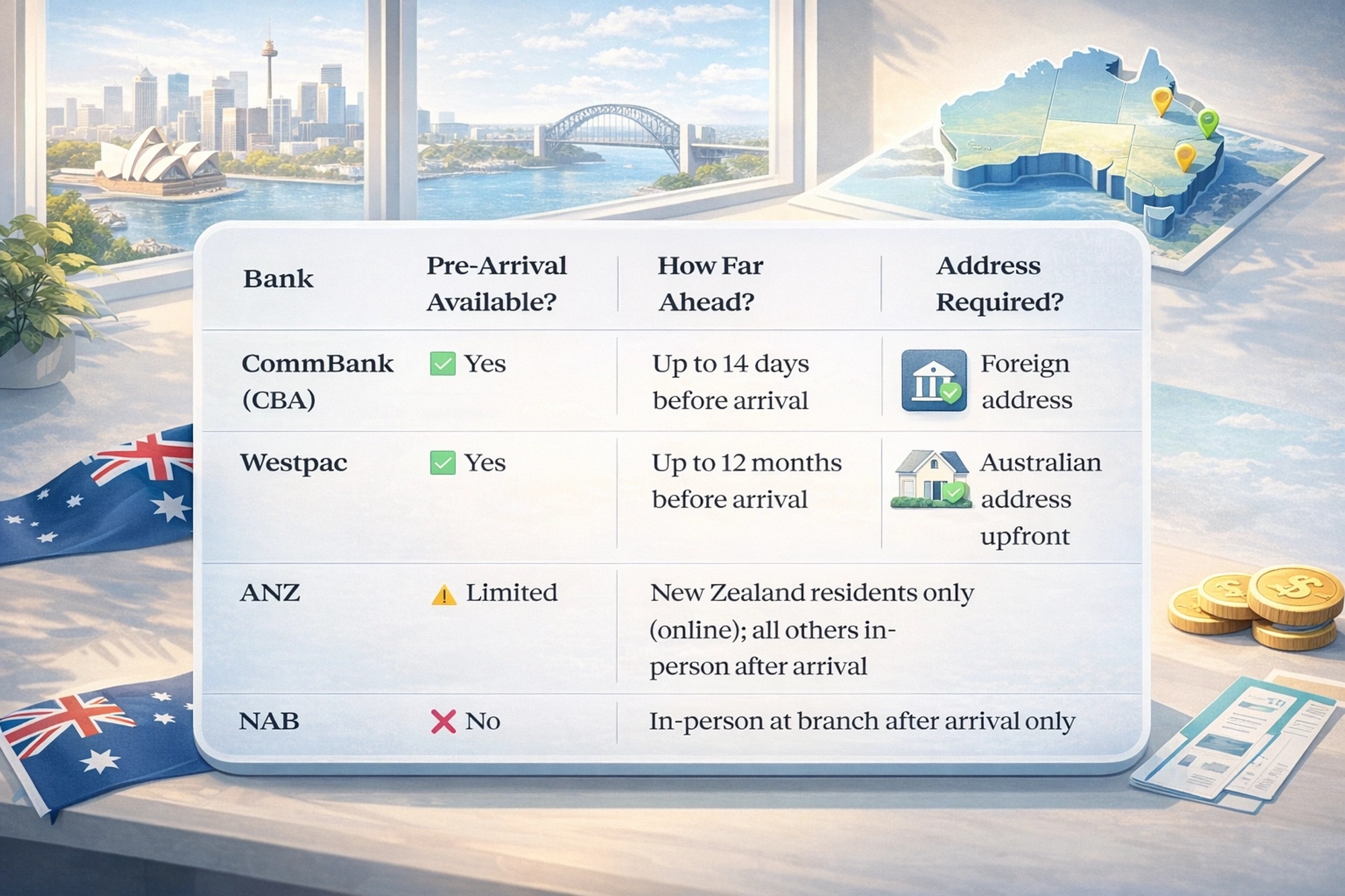
The address problem: Most migrants haven't secured a permanent Australian address before departing. CommBank's policy of accepting a foreign address for the initial application solves this for the majority of people. Westpac's pre-arrival service requires a confirmed Australian address, which makes it the better choice only if you've already secured accommodation before departure.
SettleMate's Tip: SettleMate recommends CommBank's pre-arrival "Moving to Australia" portal for most migrants who haven't yet confirmed their Australian address. Apply up to 14 days before your flight, transfer some funds into the deposit-only account before departure, and then walk into a CBA branch in your first few days to activate it. You'll land with money already waiting for you in an Australian account, which takes significant pressure off those first 48 hours. Do not transfer your entire savings before landing, however, keep a buffer accessible via an overseas card or Wise until your account is fully activated.
🪪 STEP 3: Identity Verification — The Rules Every Migrant Must Know
🔍 The KYC Process and Your 6-Week Window

Under Australia's Anti-Money Laundering and Counter-Terrorism Financing Act 2006 (AML/CTF Act), every Australian bank must verify your identity before giving you full account access. This is the Know Your Customer (KYC) process and it cannot be completed remotely. You must visit a branch in person.
✅ The 6-Week New Arrival Exemption
Here is something many migrants don't know, and it's genuinely important: if you visit a bank branch within 6 weeks (42 days) of your arrival in Australia, your foreign passport alone is sufficient to satisfy identity verification.
Banks recognise that you cannot reasonably be expected to have Australian secondary documents — a driver's licence, utility bills, or Medicare card — immediately after arriving. Your passport, presented within that 6-week window, is accepted as full proof of identity.
After the 6-week window closes, the full requirements kick in — and you would typically need additional Australian-issued documents that may take months to obtain.
The strategy is simple: go to your bank branch in week one. Do not leave it until week five.
✅ What to Bring to Your Branch Visit
For most migrants in the first 6 weeks:
- Your valid foreign passport (with your visa grant visible, or bring your visa grant notice)
- Your bank's welcome letter or confirmation email (for pre-arrival applicants)
- A temporary Australian address — hotel, Airbnb, or a friend's place is perfectly fine
SettleMate's Tip: SettleMate strongly recommends booking your branch visit for Day 2 or Day 3 after landing — not Day 40. The 6-week passport exemption is generous, but life gets busy and the deadline sneaks up fast. Missing it means you'll need to gather additional Australian documents that you may not yet have, which can lock you out of full banking access at exactly the moment you need it most.
🏛️ STEP 4: The Big Four Banks Compared for Migrants
🔎 Choose the Right Bank for Your Situation

Australia's banking sector is dominated by four major institutions — CBA, NAB, Westpac, and ANZ — collectively known as the Big Four. Together they hold approximately 70–80% of household deposits. All are regulated by the Australian Prudential Regulation Authority (APRA) and covered by the Australian Government's Financial Claims Scheme, which protects deposits up to $250,000 per account holder per institution.
Here is how they compare for migrants in 2026:
🟡 CommBank (Commonwealth Bank of Australia)
- Pre-arrival online account opening up to 14 days before arrival via the Moving to Australia portal
- Foreign address accepted for initial application — no Australian address needed upfront
- Monthly account fee: $0 for those under 30, or if you deposit $2,000+ per month; otherwise $4/month
- Largest branch and ATM network in Australia
- Multilingual staff at many branches — helpful if English is your second language
- Highly rated CommBank app (Canstar Digital Banking Bank of the Year 16 years running as of 2025)
- Approximately 1 in 2 new migrants to Australia bank with CommBank
🔵 NAB (National Australia Bank)
- In-person application at branch required after arrival (no pre-arrival online option)
- NAB Classic Banking account: no monthly account-keeping fees, no minimum balance, no conditions — permanently
- Full account functionality immediately after in-person ID verification (no deposit-only period)
- Strong NAB migrant banking page with detailed guidance
- Good branch network nationally
- The long-term cost advantage is real: you won't need to switch accounts once introductory offers from other banks expire
🔴 Westpac
- Pre-arrival account opening up to 12 months before arrival — but requires a confirmed Australian address
- No monthly fees for the first 12 months (conditions apply after that)
- Member of the Global ATM Alliance — fee-free withdrawals at partner bank ATMs internationally
- Good PayID integration (instant payments via mobile number)
- Strong option if you have family or a confirmed rental address to provide upfront
🟢 ANZ
- ANZ traditional accounts require in-person branch application after arrival for most countries
- ANZ Plus (app-only account): no monthly fees, clean interface — but requires Australian mobile number for setup and onshore selfie verification
- Fee waiver for under 25s, students, or deposits of $2,000+ per month on standard accounts
- $0 account-keeping fees for the first year on the Access Advantage account
- Good choice for those comfortable with fully digital banking who don't need regular branch access
SettleMate's Tip: SettleMate's general recommendation is CommBank for your first account if you haven't secured Australian housing yet — their pre-arrival portal and foreign address policy remove the biggest friction point. Once you're settled and know your situation better, consider opening a NAB Classic account as a fee-free secondary or replacement account. The permanently-free structure makes it an excellent long-term base account, especially after CommBank's fee waivers expire.
📱 STEP 5: Neobanks and Digital Options — Wise, Up Bank, and ING
💡 The Smart Migrant's Digital Banking Toolkit

Beyond the Big Four, several digital-first options are particularly useful for migrants. These are not replacements for a traditional bank account — you will still need one of the Big Four for most employers, rental bonds, and direct debits — but they are powerful complements that can save you a significant amount of money.
🌍 Wise (formerly TransferWise)
Wise is not a bank, but it provides AUD account details (BSB and account number) and a debit card that works in Australia and internationally. It is especially valuable in your first days because:
- You can open a Wise account and have it fully functional before arriving in Australia
- Wise provides real Australian bank details (BSB + account number) so employers or agents can transfer money directly to you
- International transfers use the mid-market exchange rate with low, transparent fees, significantly cheaper than bank international transfers
- You can hold money in 40+ currencies simultaneously
- Wise is not covered by the Australian Government's Financial Claims Scheme (it is not an APRA-regulated ADI), so it is best used as a transfer and spending tool, not a primary savings account
🟡 Up Bank
Up is an Australian neobank backed by Bendigo and Adelaide Bank (a licensed ADI, so your deposits are APRA-protected and FCS-covered). Highlights:
- No monthly fees, no minimum balance
- Outstanding mobile app with real-time spending notifications and automatic transaction categorisation
- Excellent savings tools — multiple "Savers" with goal tracking
- No foreign transaction fees (good for online shopping from overseas stores)
- Requires an Australian address and phone number to set up — best suited for after you've landed and are a bit more settled
🟠 ING
ING is a well-established digital bank in Australia offering fee-free everyday banking. Worth considering as a secondary account once you're settled, particularly for the savings rate on their linked Savings Maximiser account. Note: requires an Australian address and does not offer pre-arrival setup.
SettleMate's Tip: SettleMate's recommended two-account strategy for new migrants is: open a CommBank or NAB account as your primary account for receiving salary, paying rent, and direct debits — and use Wise as your international transfer and daily spending tool while you're in your first weeks. Once you're settled, add Up Bank as a savings account. This combination covers everything and minimises fees across all your banking needs.
🏃 STEP 6: Your First Week — Activating Your Account
⚡ What to Do in Your First 72 Hours
The moment you land, your banking clock starts ticking. Here is your priority sequence:
✅ Day 1 (Airport or first evening):
- Buy an Australian SIM card — either at the airport or a nearby store. You need an Australian mobile number for bank app setup, OTP codes, and PayID. Prepaid options from Optus, Telstra, or Woolworths Mobile are widely available at the airport.
- Download your bank's app and confirm your login works
✅ Days 2–3 (First branch visit):
- Visit your nominated bank branch with your passport and any pre-arrival welcome letter
- Complete identity verification — your passport alone is sufficient in the first 6 weeks
- Activate full account access (no longer deposit-only)
- Set up PayID — link your Australian mobile number to your account for instant payments. Anyone can then send you money instantly just by entering your phone number, which is how many private landlords and friends will transfer money
- Order your physical debit card if not already issued
✅ Within the first 2 weeks:
- Apply for your Tax File Number (TFN) at ato.gov.au — takes up to 28 days to arrive by mail, so apply as early as possible
- Add your TFN to your bank account once received (see Step 7)
- Set up internet banking and enable push notifications
SettleMate's Tip: SettleMate recommends visiting the bank branch on Day 2 or 3, not "sometime in the first few weeks." We regularly hear from migrants who put this off and then found themselves without cash access during a rental inspection or at the start of a new job. The branch visit takes less than 30 minutes. Do it early.
🧾 STEP 7: Adding Your TFN — The Step Most Migrants Miss
📋 Your TFN and Withholding Tax
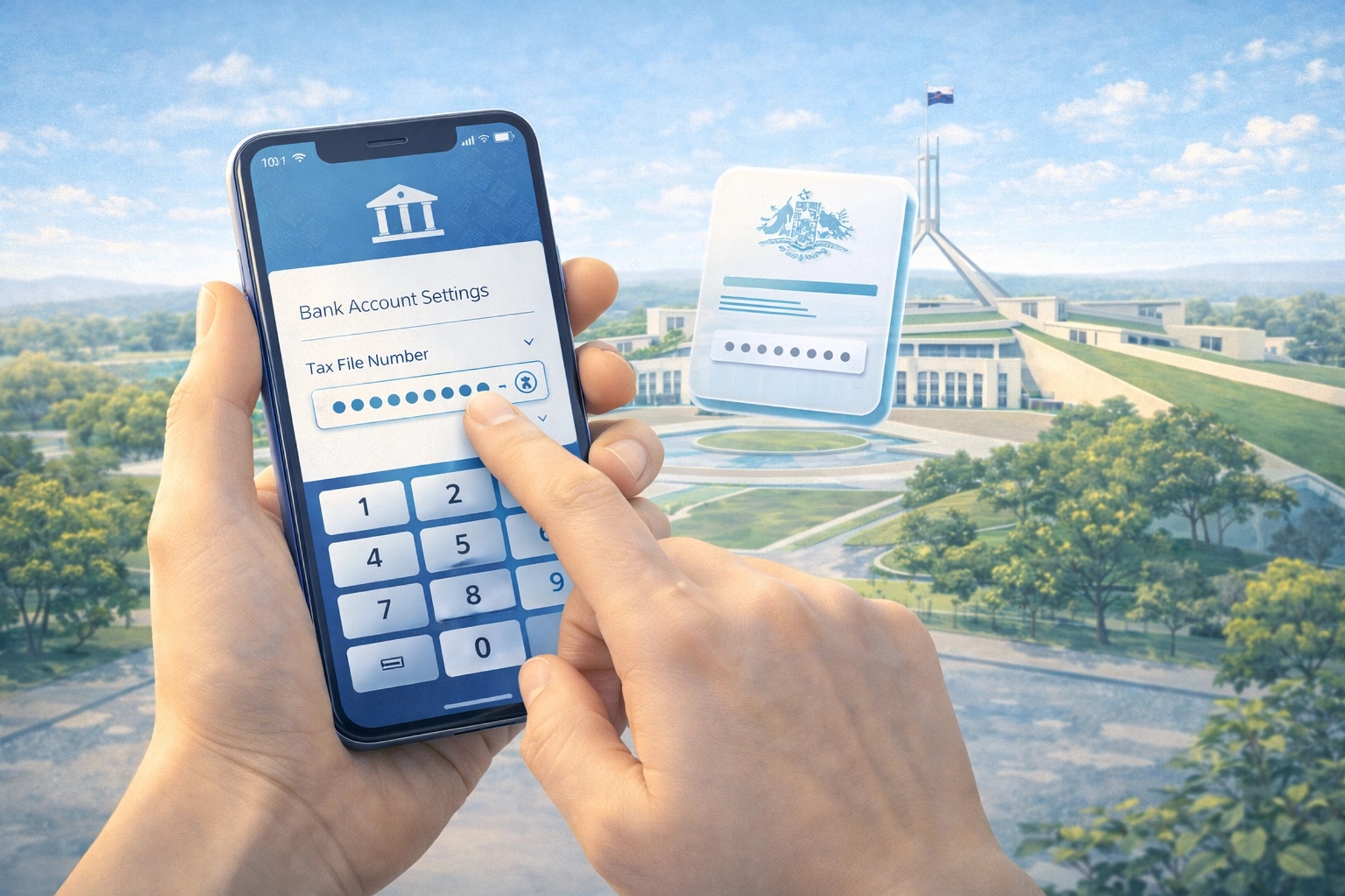
A Tax File Number (TFN) is your personal tax identifier issued by the Australian Taxation Office (ATO). It is separate from your bank account — but it is directly connected to how your account is taxed.
✅ Why Your TFN Matters for Banking
If you do not provide your TFN to your bank, the bank is legally required under ATO rules to withhold tax from any interest your account earns at the highest marginal tax rate plus the Medicare Levy — which is currently 47% for residents. This applies regardless of what your actual income level is.
The withheld tax is sent to the ATO, not lost forever — you can claim it back when you lodge your tax return. But that means the ATO holds your money all year while you earn no interest on it. It is a needless cost and administrative inconvenience.
The fix is simple: apply for your TFN at ato.gov.au as soon as you land, then add it to your bank account the moment it arrives.
✅ How to Add Your TFN to Your Bank Account
- Log into your internet banking or bank app
- Go to Account Settings or Profile
- Find the Tax Information or TFN section
- Enter your TFN as provided on your TFN letter from the ATO
Note: Your TFN can take up to 28 days to arrive by mail if you applied online. Apply immediately after landing — do not wait.
SettleMate's Tip: SettleMate recommends applying for your TFN online at ato.gov.au within the first few days of arriving — you do not need your TFN to open a bank account, but you should add it to your account the moment it arrives. If you delay and your account earns interest before you've added your TFN, you'll pay withholding tax at the maximum rate for that period. It is avoidable with one simple step.
🗣️ STEP 8: Australian Banking Terms You Will Hear Constantly
📖 The Banking Glossary for New Arrivals
Australian banking has its own vocabulary. These terms will come up constantly once you are set up:
BSB Number: A six-digit Bank State Branch number that identifies which specific branch your account is held at. Every bank transfer in Australia requires both a BSB and an account number. A BSB is not secret — share it freely when giving someone your banking details.
Account Number: Between six and ten digits, unique to your account. Combined with your BSB, this is how anyone sends you money.
PayID: Australia's instant payment system. You can link your Australian mobile number (or email address) to your account as a PayID. When someone has your PayID, they can transfer money to you instantly without needing your BSB and account number. Set this up at your branch or in your banking app.
BPAY: Australia's national bill payment system. Most utility bills, internet providers, and council rates include a BPAY biller code and reference number. You can pay any BPAY-enabled bill directly from internet banking — no card needed.
Direct Debit: An instruction that allows a company to automatically withdraw an agreed amount from your account on a regular schedule. Rent, phone plans, utilities, gym memberships, and streaming services are commonly paid this way.
Transaction Account: The everyday account you use for spending, receiving salary, and paying bills. Also called a "chequing account" in some other countries.
Savings Account: A separate account linked to your transaction account, designed for storing money and earning interest. You can open one alongside your everyday account.
EFTPOS: Electronic Funds Transfer at Point of Sale — the Australian name for paying by card at a store or restaurant. Pronounced "ef-tee-poss."
Tap and Pay: Contactless payment using your debit card or phone (Apple Pay / Google Pay). Widely accepted across Australia — cash is increasingly rare in urban areas.
📌 Official & Trusted Resources
This guide is informed by:
- Australian Prudential Regulation Authority (APRA): apra.gov.au — Financial Claims Scheme, ADI list
- Australian Taxation Office (ATO): ato.gov.au — TFN applications, withholding tax rules
- AUSTRAC: austrac.gov.au — AML/CTF Act 2006, identity verification obligations
- CommBank Moving to Australia portal: commbank.com.au/moving-to-australia
- Wise Australia: wise.com/au
⚠️ Verification note: Bank-specific pre-arrival timelines, fee structures, and address policies should be confirmed directly on each bank's website before following, as these change periodically. The core identity verification rules (AML/CTF Act, 6-week passport exemption, TFN withholding) are verified from official sources and are accurate as of March 2026.
Disclaimer
This guide is provided for general informational purposes only. While SettleMate strives to keep all information accurate and up to date, requirements and processes may change and can vary by individual circumstances or state and territory. This content does not constitute legal, tax, migration, or financial advice. SettleMate is not a registered migration agent or financial advisor. Always verify important details directly with your chosen bank, and check official sources such as apra.gov.au and ato.gov.au. For visa and migration matters, consult a registered migration agent (MARA agent).
Sharing & Usage
This guide is original content created by SettleMate. You are welcome to share, link to, or quote this guide for personal, educational, or non-commercial purposes, provided SettleMate is clearly credited as the source.
© SettleMate. All rights reserved. settlemate.au
Made with ❤️ for immigrants in Australia
Can I open an Australian bank account without an Australian address?
Yes — CommBank's pre-arrival portal accepts a foreign residential address for the initial online application. You will need to provide an Australian address at the time of your branch visit to activate the account. A temporary address such as a hotel, Airbnb, or a friend's place is accepted.
Can I open a bank account on a Working Holiday visa (417 or 462)?
Yes. Working holiday visa holders are treated as migrants for banking purposes in Australia. You can open an account in person at any of the Big Four banks after arriving — bring your passport with your visa grant visible. Pre-arrival online options are also available for some banks.
Can I open an account on a tourist/visitor visa (subclass 600)?
Pre-arrival and most online account opening services require a work-eligible visa. Tourist visa holders (subclass 600, 601, 651) generally need to apply in person at a bank branch after arriving and may face additional restrictions. Wise is a useful alternative for short-term visitors who need AUD access.
What happens if I miss the 6-week window for identity verification?
If you do not complete in-person identity verification within 6 weeks of arriving, you will no longer be able to use your passport alone as ID. Banks will require additional documents — typically an Australian driver's licence, Medicare card, or utility bill — that may take time to obtain. This can delay full account access. Contact your bank directly if you approach the deadline and are having difficulty getting to a branch.
Do I need a TFN to open a bank account?
No — you do not need a TFN to open a bank account. However, if you do not provide your TFN to your bank once it is issued, the bank is required to withhold tax at the highest marginal rate (currently 47%) on any interest you earn. Apply for your TFN at ato.gov.au as soon as you arrive, and add it to your bank account the moment it arrives.
Can international students open a bank account?
Yes. International students on a subclass 500 visa can open an account at any major Australian bank. Bring your passport, your Confirmation of Enrolment (CoE) from your institution, and your visa grant notice. Students may also qualify for fee waivers on certain accounts — ask at the branch.
Can I send money overseas from my Australian bank account?
Yes. All major banks support international transfers, but fees and exchange rates vary significantly. Bank-to-bank international transfers typically cost $6–$30 per transaction plus a 2–4% exchange rate margin. Services like Wise offer significantly better rates and lower fees — typically 0.4–0.6% on the transfer value — and are recommended for regular overseas transfers.
Let's chat like humans, not forms
Answer a few quick questions and we'll route your note to a certified expert, no matter where you are in the world.
SettleMate Response Promise
Every conversation is reviewed by a specialist within 24 hours (often much sooner), and you'll always get a personalised next step.
- Thoughtfully reviewed by a real specialist.
- Personalized replies tailored to your unique situation.
- Actionable next steps, delivered clearly after each consultation.
Need something faster?
Reach us directly
Prefer a quick reply? Use any of the touchpoints below and our concierge team will jump in.